Business
Owning Maple Leaf Hotel in Masaka City; A dream come true for business man Ssempijja

Maple Leaf Hotel in Masaka City
By. BRIAN MUGENYI- Masaka City
The early beginnings of Jamil Ssempijja as the proprietor of Maple Leaf Hotel is the one that is full-filling.
At Masaka City, Kampala Highway, Ssempijja erected a multi- business hotel.
A good way of starting Ssempijja’s hotel business story could be beffiting to rant about his initial experience onto his tours in countries; United States, Thailand, Holland and Dubai as it’s outer looks bespoke determination and international standard outlook.
https://youtu.be/h47plXYhTTY
Ssempijja had been in the business before as a retailer contracted by Celtel and Pepsi products distributor in Masaka City in 2003.
First, Ssempijja’s hotel business idea emanated as early as 2008 after purchasing the land but it grew yonder when he visited the third most top building in the world, Twin Tower in Malaysia which inspired him to built what today counts as a grass-thatched Maple Leaf hotel, one of its kind in Masaka City.
The dream was alive but the capital wasn’t sufficient until when he saved the little meagre pocket money he had to start what today counts as a 6-billion project.

Buganda’s premier Charles Peter Mayiga accompanied with the Hotel manager Julius Matooma and the owner of the hotel Hajji Jamil Ssempijja recently
Jamil born at Ninzi Village in Kasaali subcounty, Kyoteta District attained a Diploma in Business Administration at Nkumba University which all propelled his zeal to invest heavily into the business sector.
Maple Leaf Hotel today, accomodates three conference rooms; 250, 150, 40 people respectively and Ssempijja has not been selfish to involve his family too into the management.

Such facilities and services are charged ranging in; 800,000, 400,000, 300,000 respectively.
It is the patience, connection and unity and determination that has propelled Maple Leaf Hotel into a successful facility ready to serve all and sundry in Masaka City according to Moses Mutagubya also the son of the owner Ssempijja.
The two halls; Nambaale and Ssuubi have all attracted clients giving Ssempijja a reason to believe how far he has come and how far he has gone as far as business is concerned.
What's your reaction?
Excited
1
Happy
1
In Love
1
Not Sure
0
Silly
0
You may also like
More in:Business

Personal care is not a gender issue. It is a matter of health, hygiene and self-confidence
By Celine Najjemba Ask many Ugandan men about their skincare routine and you will likely ...
AAYC, NIMD Explore Strategic Partnership to Advance Youth Leadership, Democracy and Peacebuilding
The Afro-Arab Youth Council (AAYC) and the Netherlands Institute for Multiparty Democracy (NIMD) are exploring ...
PRESIDENT MUSEVENI URGES SHEEMA FARMERS TO EMBRACE IRRIGATION, COMMERCIAL AGRICULTURE TO FIGHT POVERTY
President Yoweri Kaguta Museveni has urged farmers in Sheema District to embrace irrigation, pasture growing, ...
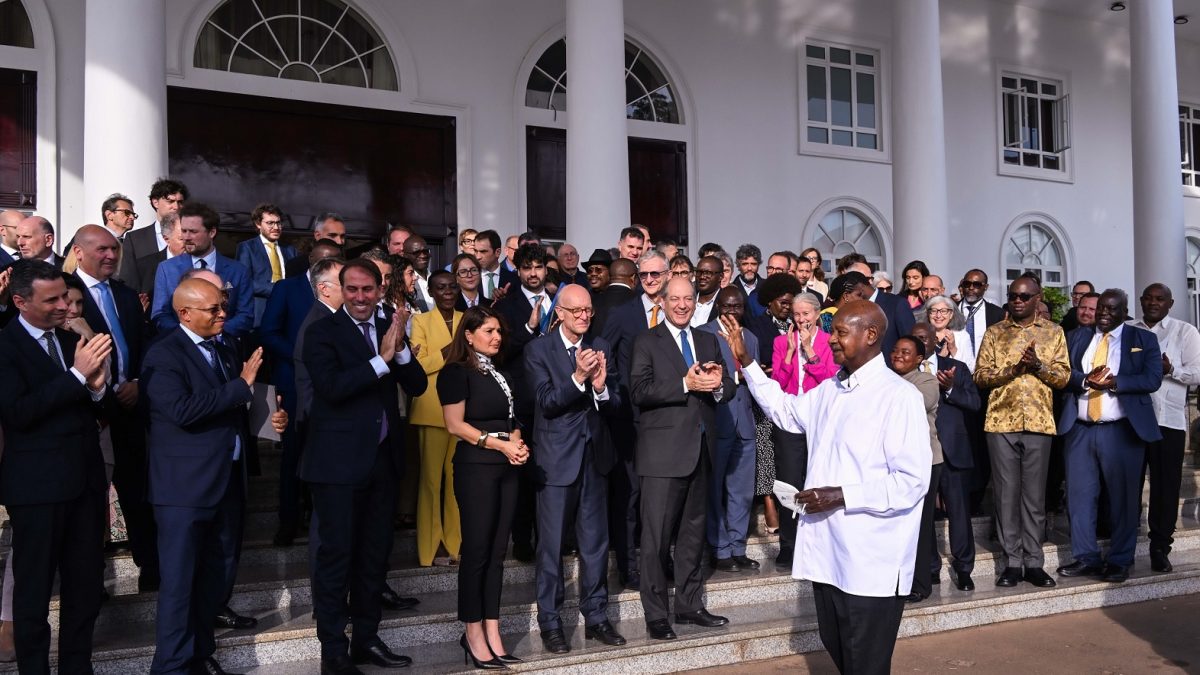
PRESIDENT MUSEVENI URGES EUROPEAN INVESTORS TO TAP INTO UGANDA’S ECONOMIC OPPORTUNITIES
President Yoweri Kaguta Museveni has urged European investors to take advantage of Uganda’s economic opportunities, particularly in infrastructure, energy, manufacturing and agriculture, saying investment in productive sectors is key to expanding markets, creating jobs and accelerating economic transformation. The President made the remarks today at State House Entebbe during a meeting with European Union Ambassadors and investors, where he highlighted Africa’s growing population and expanding market as a major opportunity for European businesses seeking investment and stronger economic partnerships. “This is what we have been advising our European friends to look at, because Africa is a big potential market with its fast-growing population,” he said. President Museveni attributed political instability in some African countries partly to identity-based politics, including tribalism, religious divisions and ideological misunderstandings, as well as a failure to appreciate the role of the private sector in driving economic growth. He said Uganda had learnt from these challenges and emphasised the need for a stable political and economic environment that enables private businesses to invest, expand production and create employment. The President welcomed ongoing and proposed European investments in Uganda, particularly in infrastructure and other productive sectors, saying such projects would strengthen economic links between Uganda and the European market. “All these projects are music to my ears. By constructing these projects here, you are linking the market of Uganda to that of Europe. Why can’t anyone see that?” he asked. On energy, President Museveni said the cost of electricity remained a critical factor in Uganda’s competitiveness, particularly for manufacturers seeking to produce goods at affordable prices. While welcoming private-sector investment in hydropower generation, he called for greater attention to electricity tariffs, arguing that affordable power was essential for industrial expansion and economic growth. He identified affordable electricity, railway transport and accessible financing for productive investments as key priorities for strengthening Uganda’s manufacturing sector. The President cited the Uganda Development Bank as an important source of financing for businesses engaged in productive activities, explaining that the government had retained the institution to support investments capable of expanding production and creating jobs. He also urged the European Investment Bank to channel more financing into strategic infrastructure, particularly railway development, electricity generation and distribution, and selected road projects. On road infrastructure, President Museveni encouraged European investors to explore opportunities in construction and financing models, including tolling arrangements where appropriate. The President also reaffirmed the government’s support for tax incentives aimed at attracting investment, particularly in manufacturing, and emphasised the importance of enabling eligible businesses to benefit from a 10-year tax holiday. ...