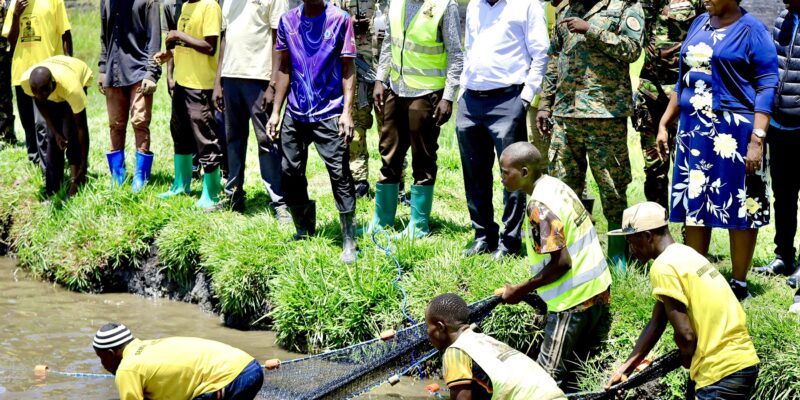
Leaders and farmers in Pallisa District have commended President
Yoweri Kaguta Museveni for spearheading a fish farming initiative aimed
at transforming livelihoods and lifting communities out of poverty.
The project is part of a broader government strategy to transition farmers
from rice cultivation in wetlands to fish farming, a more profitable and
environmentally sustainable venture.
For years, wetlands in Eastern
Uganda have been degraded by rice growing, prompting the government
to promote alternative income-generating activities that also conserve
the environment.
The fish farming projects are implemented under the Presidential Zonal
Industrial Hubs programme coordinated by State House, further
highlighting government commitment to skilling, production, and wealth
creation at the grassroots level.

As part of this strategy, the President launched the Limoto Fish Farm to
serve as a demonstration site, showcasing how fish farming can
outperform rice growing in terms of profitability while protecting
wetlands.
To support implementation, officers from the Uganda People’s Defence
Forces (UPDF) were deployed to oversee the project under the
leadership of Major David Muwanga Kibirango. His team has played a
key role in establishing and expanding the farm within a short period.
Currently, the Limoto Fish Farm has 26 fishponds, positioning it as a
model farm for farmers seeking to venture into aquaculture.
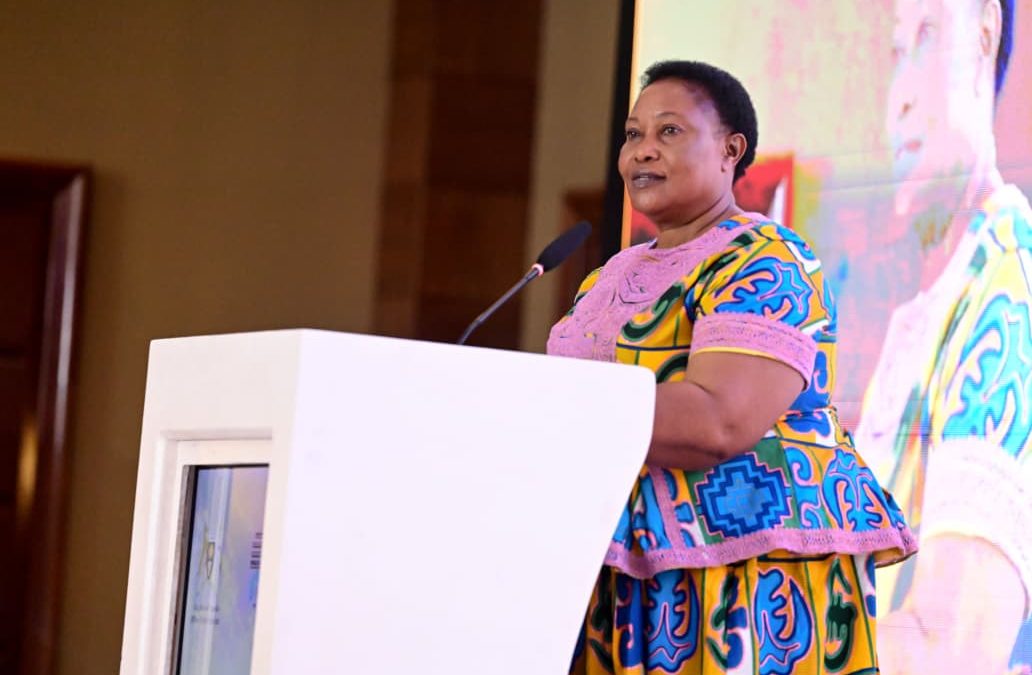
On April 20, 2026, the State House Comptroller, Ms. Jane Barekye,
visited the project site to assess its progress. She expressed satisfaction
with the development of the farm, noting that it demonstrates the viability
of fish farming as a pathway to economic transformation.
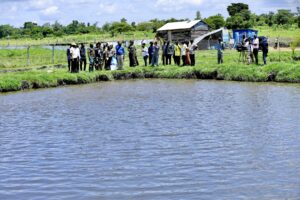
During the visit, Major Kibirango outlined the economic advantages of
fish farming, providing a comparative analysis with rice cultivation. He
explained that an acre of land can accommodate four fishponds, each
with a capacity of 15,000 fish.
According to his estimates, rice farmers typically earn about 200,000
shillings per acre after six months. In contrast, fish farming yields
significantly higher returns. Feeding costs amount to approximately
70,000 shillings per day, totalling about 15 million shillings over five
months, while labour and other expenses add up to around 5 million
shillings.
At harvest, a farmer can obtain at least 10,000 fish from a single pond,
with each kilogram selling at 7,000 shillings.
This translates to about 70million shillings per pond within five months. With four ponds per acre,
earnings can rise to approximately 280 million shillings, making fish
farming far more profitable than rice growing.
Major Kibirango called on the government to continue supporting
farmers and encouraging wider adoption of fish farming, noting its strong
potential to improve household incomes.
From Limoto, Ms. Barekye proceeded to the Kaitambiri Fish Farm
project, another initiative supported under State House.
The Resident District Commissioner for Pallisa, Mr. Majid Dhikusooka,
revealed that the project was established following his appeal to the
President to extend similar support to farmers who could not be
accommodated at Limoto.
Through collaboration between the Ministries of Water and Environment,
Agriculture, and State House, six fishponds have so far been established
at Kaitambiri, all with fish.
Mika Makeri, the chairperson of fish farmers at Kaitambiri, praised the
initiative, describing it as a turning point for income generation in the
area. He noted that many farmers had long relied on rice cultivation,
which yielded minimal returns while contributing to environmental
degradation.
However, he highlighted several challenges affecting farmers, including
limited market access, insecurity at fishponds, and the high cost of fish
feeds.
In response, the State House Comptroller unveiled Masheda Holdings
Company Limited as a ready market for the farmers’ fish.
David Osiya, a representative of the company, assured farmers of
guaranteed market access, with catfish priced at 7,000 shillings per
kilogram and tilapia at 7,500 shillings.
He further disclosed plans to establish a fish feeds factory to address the
high cost and scarcity of feeds.
Addressing the farmers, Ms. Barekye urged them to take full ownership
of the project, emphasizing that the President has already invested over
one billion shillings into the initiative.
“You all have to move out of poverty. Just embrace this project and you
will see the transformation,” she said.
She also warned individuals who may attempt to sabotage the project,
stating that firm action would be taken against offenders. She urged
farmers to report theft and cautioned security personnel to ensure the
safety of the fishponds.
Ms. Barekye further assured the farmers that State House would support
the project by installing a perimeter fence and providing additional
resources to guarantee its sustainability.
The fish farming initiative is increasingly being viewed as a
transformative intervention, offering both economic and environmental
benefits to the people of Pallisa and surrounding areas.
What's your reaction?
You may also like

More in:Business

From the Lab to Your Bathroom Shelf: Why I’m Proud to Sell UBeauty

Minister Babalanda Calls for Financing Architecture to Match Uganda’s US$500 Billion Growth Ambition by 2040

PRESIDENT MUSEVENI COMMENDED FOR SKILLING INITIATIVE AS STATE HOUSE ANNOUNCES NEW HUB IN BUSOGA
Namayingo Farmers Confront Sugar Council Over Delayed CN Sugar Licence