One Mic, One Man, One Mission: How Moses AK Gumisiriza Became the Sound of the NRM, PLU
Kampala, Uganda

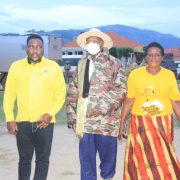
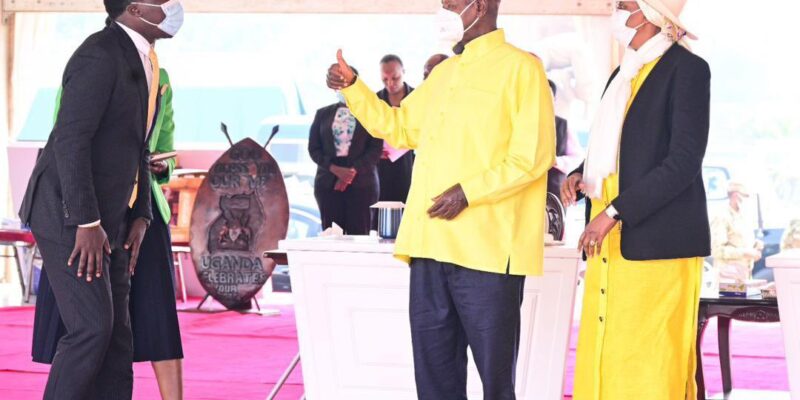
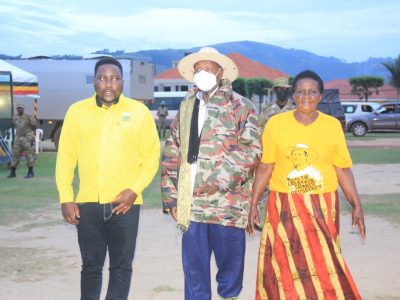
Moses Gumisiriza talking to President Museveni and first Lady at one of the events where he was an emcee
There is a particular kind of man who does not find his calling, his calling finds him. It arrives unannounced, usually disguised as something ordinary: a borrowed microphone, a small studio, a crowd that goes quiet when he opens his mouth. For Moses Gumisiriza aka Moses AK, the calling arrived in the highlands of southwestern Uganda, in a district called Rukungiri, where the hills are ancient and the mornings carry the smell of rain even when there is no rain coming.
He was just a boy from those hills when he first wrapped his hand around a microphone and understood, in the wordless way that destiny makes itself known, that this was it. This was the thing. Not farming. Not something behind a desk. The microphone. The crowd. The words that could turn a stadium of strangers into one breathing, feeling, responding body.
What he could not have known then standing in that modest studio in Rukungiri, wrestling sports scores into sentences, is how far that microphone would eventually take him. How many districts. How many thousands of faces. How many generals and presidents would one day stand beside him on a stage while his voice carried the moment to everyone assembled below.
This is the story of Moses Gumisiriza. It is a story about talent, loyalty, and a journey that began with a radio and ended, or perhaps has not yet ended, at the centre of Uganda’s political life.
From Rukungiri to Kabale: The Radio Years
The road from Rukungiri to the wider world runs through several towns, and Moses AK walked it gradually, as a man should one station at a time. His first posting was at a radio studio in his home district, where he reported on sport with the enthusiasm of someone who genuinely loved what he was covering. Football results. Match previews. The small, thrilling drama of local leagues.
He moved on to Kanungu, another chapter added to what was becoming a quiet but purposeful career. And then came Kabale, the municipal town in the highlands of Kigezi, where the air is cool and the landscape could make a grown person weep with its beauty. At Voice of Kigezi FM, Moses Gumisiriza found his home.
For more than a decade, that radio station was where he lived professionally. Listeners in Kabale and the surrounding districts woke up to his voice the way they woke up to the sun-expecting it, depending on it, noticing when it was absent. He was the sports presenter who made the ordinary feel significant, who understood that a football match is never just a football match; it is a community measuring itself, celebrating itself, suffering itself.
He made every game feel like history being written in real time.
But Kabale was not only shaping the broadcaster. It was shaping the man. Moses enrolled at Kabale University and completed a Degree in Social Work and Social Administration a choice that reveals something essential about his character. Behind the showmanship and the silver tongue was a person who thought about people. About how communities work and break and heal. About society and the bonds that hold it together or pull it apart.
That education would matter later. Because what Moses was preparing for without fully knowing it yet was not just entertainment. It was influence.
The Leap: Leaving the Studio for Something Larger
There is a phrase that journalists use when a story gets too big for one beat: the story finds its own legs. Something similar happened to Moses Gumisiriza after more than a decade at Voice of Kigezi. The story of his life got too big for the radio studio. It found its own legs. And it walked him out the door and into something he could not have scripted.
He left Voice of Kigezi FM to serve the Patriotic League of Uganda and the National Resistance Movement. Within weeks not months, weeks he was standing at Bombo Military Barracks, microphone in hand, presiding over one of the most significant ceremonies Uganda’s military had seen in recent years.
General Muhoozi Kainerugaba was being promoted. From Lieutenant General to Full General. The promotion was conducted by his uncle, the legendary General Salim Saleh one of Uganda’s most decorated and storied military figures. And the man at the microphone, giving voice to this occasion, threading the ceremony together with authority and composure, was Moses Gumisiriza, the boy from Rukungiri.
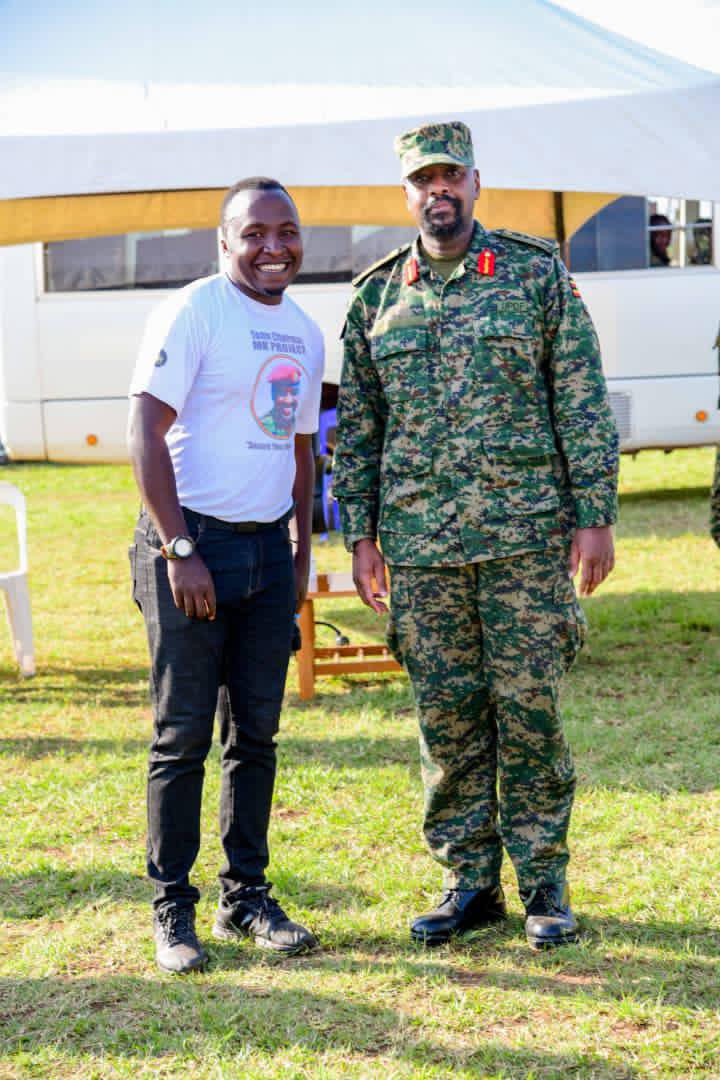
Moses Gumisiriza poses for a photo with Gen MK when he emceeing at Bombo military barracks
To be trusted with such a moment so quickly after leaving radio speaks either to remarkable luck or to a reputation so solid it preceded him everywhere he went. Those who know Moses will tell you it was not luck.
Within weeks of leaving radio, he was on stage at Bombo Military Barracks, MCing a general’s promotion. That does not happen by accident.
What followed Bombo was a season of relentless movement. The Patriotic League of Uganda had functions across the country gatherings large and small, north and south, urban and deeply rural and at every one of them, Moses was at the microphone. Kampala. Masaka. The Kigezi region. The North. The East. Wherever Gen MK went, the crowd found Moses already there when they arrived, already warming the air, already making the space feel ready.
‘I Will Die With Him’: The Declaration That Defined a Loyalty
Somewhere in the middle of all that movement, Moses Gumisiriza took to his X account using his handle @AK_mose and posted a declaration that people still talk about. He said in words that were blunt and absolute and entirely characteristic of the man that he would die with Gen Muhoozi Kainerugaba, come what may.
The internet, predictably, had opinions. Some marvelled at the commitment. Others raised an eyebrow. Some misread it as the melodrama of a man caught up in a political moment.
Those who know Moses read it differently. They read it as a man being honest about where he stood. In a world of political performers of people who wear allegiances the way others wear seasonal clothing, taking them on and off as the weather demands Moses was saying, in the most unambiguous language he could find: I am not performing. This is real. This is permanent.
Whether he will one day elaborate on precisely what he meant by those words -whether he was speaking to survival, to principle, to something else entirely, is a conversation perhaps still waiting to happen. But the sentiment at the heart of it was unmistakable. Moses Gumisiriza believed in Gen Muhoozi Kainerugaba, and he was not interested in keeping that belief quiet.
For Moses, loyalty is not a strategy. It is a worldview.
His conviction rests on an argument that he will make to anyone willing to listen. and to several people who are not. Gen Muhoozi, Moses believes, is the right hand capable of receiving the baton from President Museveni, not because of blood alone, but because of preparation. Because of proximity. Because of years spent being mentored at the foot of a man who has led Uganda for decades and who, by Moses’s reckoning, has built something worth building on.
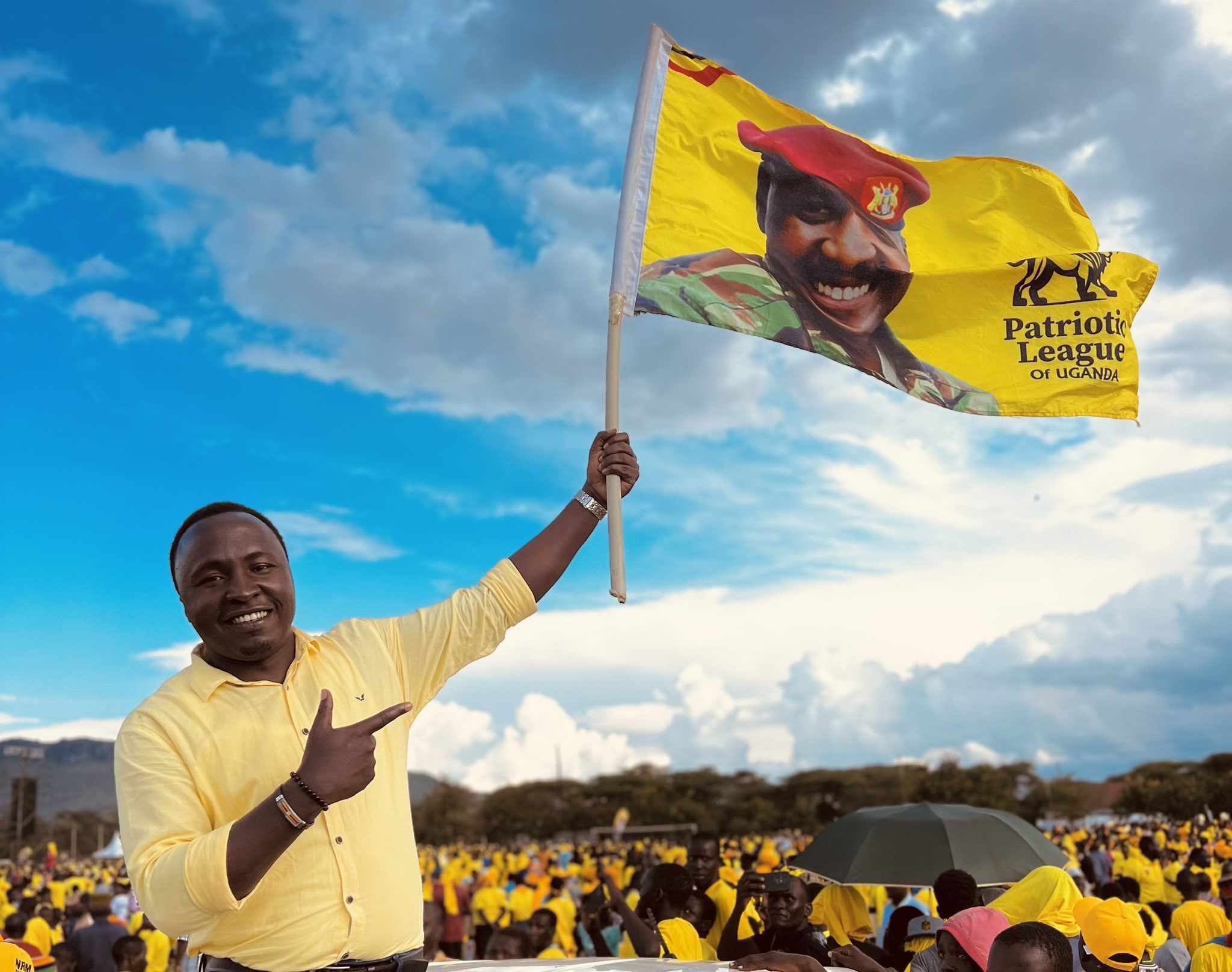
Moses Gumisiriza sees Gen Muhoozi as the right man for job, after Yoweri Museveni. According to him, Museveni has nurtured Gen Muhoozi, and for the continuity of Peace and prosperity, Gen MK is the answer
Speak ill of Museveni or Muhoozi in Moses’s presence and discover quickly what that conviction looks like when it is not pretending to be polite. He will challenge. He will argue. He will stay in the conversation until it is resolved on his terms, if possible or simply never ends. There is no third option.
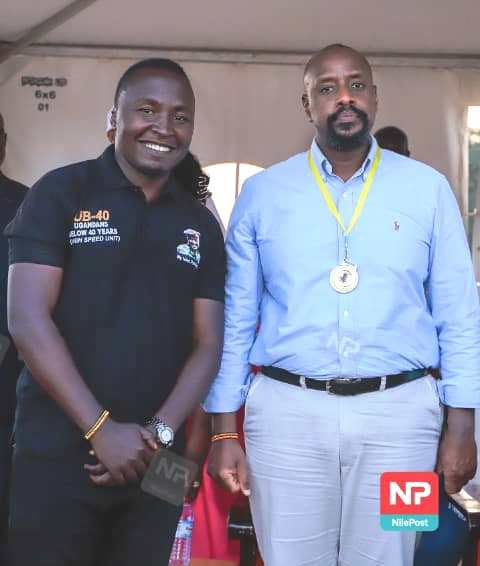
Moses Gumisiriza poses for a photo with Gen MK at one of the PLU’s functions which he was emceeing
The Election and the Seventy-One Percent
When the general elections arrived, Moses did what he has always done: he moved. He packed himself and his voice into the campaign and travelled with President Yoweri Kaguta Museveni and the full machinery of the NRM across the Ugandan countryside.
Rally after rally. District after district. Crowds that gathered under open skies, pressing forward, straining to hear and be heard. Moses was at the microphone for all of it introducing, energising, building the emotional temperature of each event to the point where the candidate could step forward and receive it.
MCing a political rally is a different skill from MCing a military ceremony. The military ceremony requires precision and gravity. The political rally requires something warmer and wilder, an understanding of a crowd’s mood, a feel for when to slow down and when to accelerate, a gift for making thousands of people feel simultaneously seen and part of something enormous.
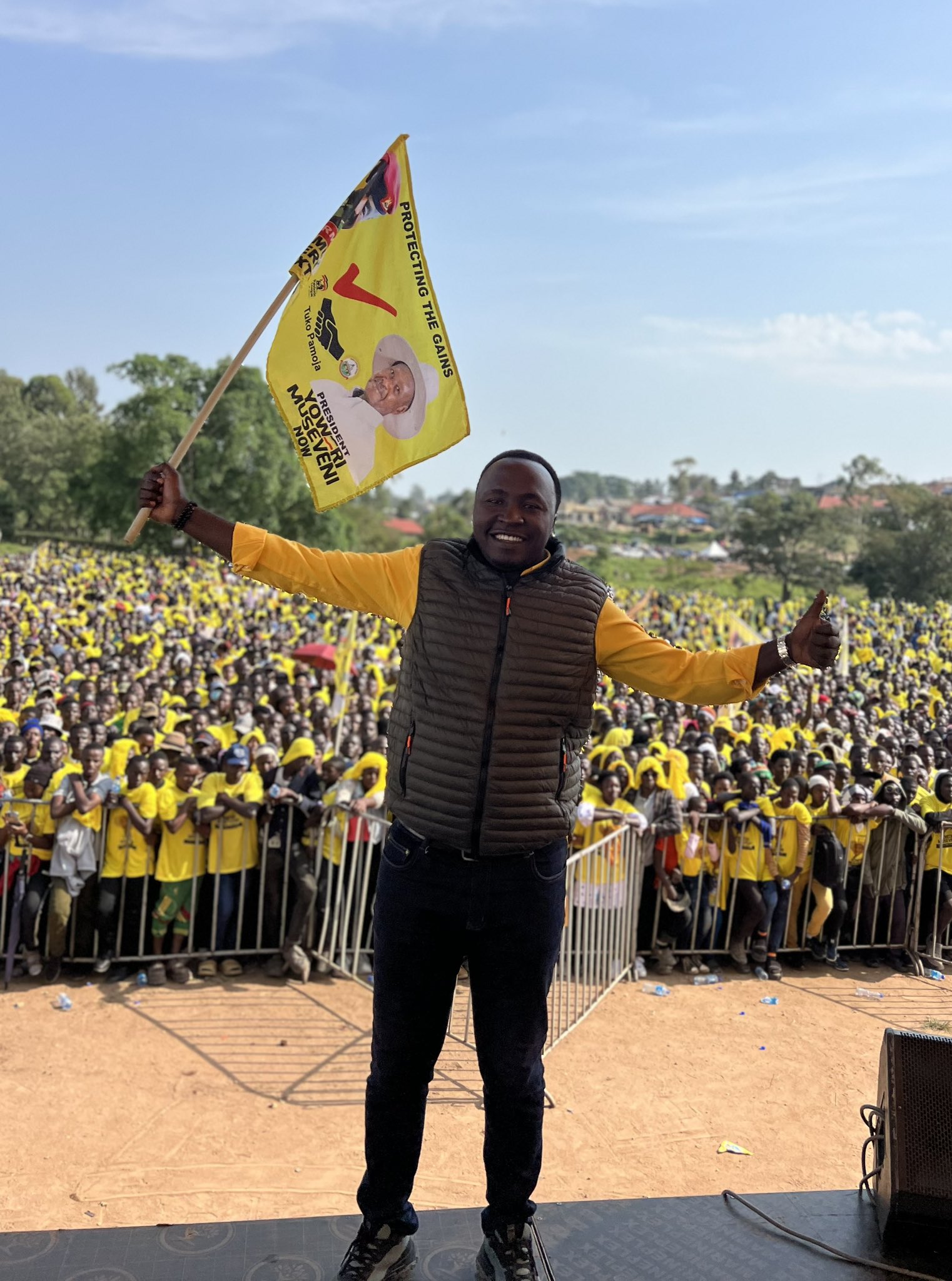
Moses Gumisiriza before a mammoth gathering during Museveni’s campaigns. He was usually an emcee at such gatherings all-over Uganda
Moses possesses both skills. And he deployed them fully across the length of that campaign.
When the results came in, President Museveni had won with seventy-one percent of the vote. A commanding figure. A decisive mandate. And behind that number, as behind all such numbers, were hundreds of rallies, thousands of conversations, and one man who spent the campaign season standing at microphones and persuading crowds that their candidate was worth believing
It would be honest more than honest, it would simply be accurate, to say that Moses Gumisiriza was among those who helped generate that special percentage. That his tongue was part of the campaign machinery. That the seventy-one percent carries, somewhere in its arithmetic, a portion of his effort.
The Voice Still on the Road
Moses Gumisiriza is not a household name in the way that presidents and generals are household names. He does not occupy the centre of the frame. He stands slightly to the side of it, microphone raised, making sure the centre holds.
But that position to the side, holding the microphone, keeping the event together, giving the moment a voice is not a small position. It is, in many ways, the most important position. The one that makes everything else possible.
He came from Rukungiri. He stopped in Kanungu. He stayed in Kabale long enough to become someone. He earned a degree. He spent a decade as a beloved radio voice. And then he walked out of that studio and into a larger story the story of Uganda’s politics, its leadership, its future and made himself indispensable to it.
Moses Gumisiriza has travelled a remarkable road. He has travelled it on the strength of one gift and one conviction: the gift of a voice, and the conviction that the leaders he follows are worth following.
The drum of Uganda’s politics will keep beating for years to come. The rallies will continue. The ceremonies will be held. The crowds will gather and wait for someone to tell them the moment has arrived.
And somewhere at the front-microphone raised, voice ready – Moses Gumisiriza will be there.
####
What's your reaction?
You may also like
More in:Analysis
We Must Honor the Builders of PLU in Western Uganda
GROW Project Raises Government Wealth-Creation Investments to UGX 10.75 Trillion
Uganda’s Cash Economy and the Bank of Uganda’s New Cash Withdrawal Limits