President Yoweri Kaguta Museveni has assured residents of Nakaseke
District, particularly those living in forest reserve areas, that the
government will not evict them but will instead formalise their stay
through lease arrangements that promote wealth creation alongside
environmental conservation.
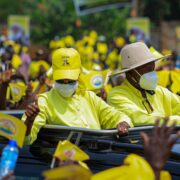
Addressing a packed campaign rally at Nakaseke District headquarters
in Butalangu on Tuesday, 30 December, 2025, President Museveni who
was accompanied by the First Lady and Minister of Education and
Sports, Maama Janet Museveni, stated that the government would
engage with settlers occupying forest reserve land and allow them to
use it under long-term leases of up to 49 years, provided they participate
in tree planting and adopt sustainable land use practices.

“We are going to arrange to enable you to enter an agreement with the
government to give you a lease on that land for something like 49
years,” President Museveni said.
“As you carry out your wealth creation activities, such as commercial
farming and grazing animals, you will be required to preserve that land
by planting trees.”
The President clarified that the land in question had originally been set
aside by the government for forest establishment, but noted that forest
restoration could still be achieved through the active participation of
communities already settled there.

“If it was a traditional forest like Budongo Forest, I would have chased
you,” President Museveni added, drawing laughter from the crowd, as he
distinguished between protected natural forests and degraded reserves
that can be restored through agro-forestry.
The assurance followed concerns raised earlier by the NRM Second
National Vice Chairperson, Rt. Hon. Annet Anita Among, who warned
that residents in forest reserves such as Kanyogoga, Kamusenene,
Wakyato, and parts of Ngoma trading centre were facing imminent
eviction by the National Forestry Authority (NFA).
She told the rally that many of the settlements had over time developed
into fully-fledged communities with schools, health centres, places of
worship, and other public amenities, making eviction socially and
economically disruptive.
Nakaseke District hosts several central forest reserves, including
Kapimpini and Kamusenene, which have come under pressure from
human settlement, agriculture, and grazing.
President Museveni, who is also the National Chairman of the National
Resistance Movement (NRM) and the party’s presidential flag bearer for
the 2026 general elections, said he was pleased to return to Bulemeezi,
describing it as a historically diverse and significant region.
“This is our traditional place with people from all walks of life —
Baganda, Banyankore, Lugbara and others,” he said.
Nakaseke lies at the heart of the Luwero Triangle, which was a major
battleground during the 1981–1986 NRA bush war.
Using the rally to campaign for renewal of the NRM mandate, President
Museveni outlined what he described as the party’s seven major
contributions to Uganda over the last four decades, urging voters to use
them as a basis for the 2026 decision. At the top of the list, he placed
peace and security.
“Uganda was in wars for a long time, even before Europeans came but it
has been 40 years since the NRM has kept Uganda peaceful.”
He argued that sustained peace had provided the foundation for
development, investment, and wealth creation across the country,
including in previously war-ravaged areas like Nakaseke.
On infrastructure, President Museveni recalled that for a long time, the
Kampala–Luwero–Gulu road was the only major road serving the region.
Since then, the government has invested in new and upgraded roads,
including the Matugga–Semuto–Kapeeka road.
“We have added on Kampala–Luwero–Butalangu, and we are going to
expand it to Ngoma up to Masindi,” he said.
The President urged voters to elect leaders who understand government
priorities and can effectively lobby for development.
“Ask the Members of Parliament you will elect to listen to my message,
especially on the issue of prioritisation,” he said.
He noted that Nakaseke previously had no electricity but now enjoys
near-universal access, with plans to extend power to remaining
unserved areas.
In education, President Museveni said the district now has numerous
primary, secondary, and technical institutions, including a teachers’
training college, compared to just a handful in the past.
Wealth creation beyond subsistence:
However, President Museveni cautioned residents against relying solely
on social services and subsistence farming, emphasising that wealth
creation at the household level was critical.
“NRM has been telling you from the beginning that you must also work
for the pocket, not only for eating,” he said.
He cited the example of George Matongo of Ngoma in Nakaseke, who
transformed his life through commercial dairy farming.
“That man collects 900 litres of milk per day, earning Shs21 million per
month and over Shs200 million in a year,” President Museveni said.
The President also challenged local dairy farmers, many of whom own
large tracts of land, to adopt intensive farming practices instead of
extensive grazing, which he described as under-utilisation of land.
“Use your land profitably by planting grass and feeding many cows in a
small place,” he advised.
To reinforce the message, President Museveni highlighted Joseph Ijara,
who runs both poultry and dairy farming on just 2.5 acres.
Ijara started with four cows, which have grown to eight, producing
between 20 and 36 litres of milk per cow per day. He also sells 600 trays
of eggs monthly.
“He earns Shs6 million from eggs and about Shs800,000 from milk,
totaling Shs6.8 million per month,” President Museveni said.
“What you need to understand is to use small amounts of land and earn
more. On one acre, you can put eight dairy cows and get out of poverty.”
Lessons from Karamoja:
President Museveni also cited examples beyond Nakaseke to show that
wealth creation is possible even in less developed regions.
He pointed to Korea Dick Ogira, a model farmer in Abim District,
Karamoja sub-region, who received 200 mango seedlings under
Operation Wealth Creation (OWC) and Shs1 million through the Parish
Development Model (PDM).
Ogira planted mangoes alongside cassava on two acres and earned
Shs12 million in the first year by selling mangoes at Shs1,000 each.
“Next year I expect to get Shs18 million, and in a year Shs32 million
after two harvests,” Ogira said in a video clip shown at the rally.
“That man is in Abim, where there is no tarmac road, but he is creating
wealth,” President Museveni said. “Development may not be there, but
wealth is there.”
Jobs come from wealth:
The President said wealth creation leads directly to job creation,
dismissing claims that government is the main source of employment.
“Government jobs are only 480,000 against a population of 50 million,”
he said. “Jobs are in commercial agriculture, manufacturing, artisanship,
services and ICT.”
He cited Johnson Basangwa of Jeka Poultry Farm in Kamuli District,
who produces 2,000 trays of eggs daily, earning about Shs20 million per
day.
“Basangwa employs 300 people,” President Museveni said. “He started
poultry on a 50 by 100 plot. His wealth has created jobs.”
The President also referenced industrial parks such as Sino-Mbale,
which hosts 75 factories employing about 12,000 workers, and Namanve
Industrial Park with 273 factories employing over 24,000 people.
Closer to Nakaseke, President Museveni pointed to Kapeeka Industrial
Park as evidence of NRM’s commitment to industrialisation and
employment.
During the rally, President Museveni acknowledged additional concerns,
including land grabbing, land use conflicts, the welfare of veterans and
former fighters, and outdated road equipment in the district. He pledged
continued engagement to address the issues.
On her part, Maama Janet thanked residents for turning up in large
numbers and urged them to protect the gains achieved under NRM.
“The people of Nakaseke must not forget that the rally should continue
on January 15 by voting for Museveni and other NRM flag bearers,” she
said.
“Vote for NRM to continue working for Uganda to be an example in
Africa — a country with families transforming themselves into wealth.”
NRM Deputy Secretary General, Hon. Rose Namayanja hailed the
transformation of Bulemeezi from a war zone to a thriving commercial
area with milk coolers and commercial dairy production.
NRM Vice Chairperson for Central Region, Hon Haruna Kasolo Kyeyune
thanked Gen. Salim Saleh for guiding Nakaseke residents on NRM
ideology and praised local leaders for avoiding NRM-leaning
independents.
Nakaseke NRM Chairperson Hajji Mohammed Ggubya welcomed
President Museveni and highlighted post-war recovery.
“Before the war, towns like Kiwoko, Nakaseke, Kapeeka and Semuto
existed, but the war destroyed them,” he said. “Now they are back with
storied commercial buildings.”
He noted that the district had one secondary school in 1986 but now has
17 government secondary schools, several technical institutions, and
over 114 government primary schools, alongside 256 private schools.
NRM Vice Chairperson for Nakaseke, Hajjat Saida Bbumba, appealed to
President Museveni to resolve land challenges hindering development.
The rally was attended by NRM Central Executive Committee members,
Ministers, Members of Parliament, former national leaders, party flag
bearers, and district officials.
What's your reaction?
You may also like


More in:National

“You Should Vote NRM For More Support” Byaruhanga Urges Market Leaders As He Sensitize Them On Katale Loans

PRESIDENT MUSEVENI ASSURES BUIKWE ON MINIMUM WAGE, SAYS GOVERNMENT MUST FIRST LOWER COST OF DOING BUSINESS

SPA Peace Rugambwa: The Strategist Redefining Mobilisation in Southwestern Uganda
COUNCIL FOR ABAVANDIMWE LEADERS RALLIES UGANDANS TO VOTE FOR PRESIDENT MUSEVENI