President Yoweri Kaguta Museveni has called for the strengthening of the
East African Common Market, warning that protectionist trade policies and
high tariffs among regional partners undermine economic integration and
deny citizens the benefits of a larger regional market.
The President made the remarks on Wednesday, July 29, 2026, at State
House, Entebbe, while receiving Letters of Credence from four Heads of
Mission-designate, officially accrediting them to represent their respective
countries in Uganda.
The envoys who presented their credentials were Kenya’s High
Commissioner-designate, Amb. Ababu Namwamba; the Republic of
Korea’s Ambassador-designate, Sangho Lee; Tanzania’s High
Commissioner-designate, Maj. Gen. Marco Elisha Gaguti; and Namibia’s
High Commissioner-designate, Gabriel Pandureni Sinimbo.
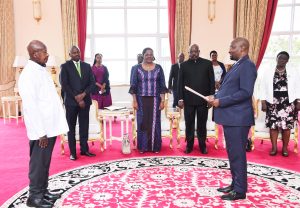
During his meeting with Kenya’s High Commissioner-designate, Amb.
Namwamba, President Museveni emphasized the need for East African
countries to deepen economic integration by removing barriers to trade.
President Museveni observed that imposing high taxes and restrictions on
goods moving between Uganda and Kenya weakens the East African
Common Market and ultimately hurts ordinary citizens and businesses.
He argued that East Africa’s prosperity depends on creating a larger
integrated market, drawing lessons from the evolution of the United States.
“The United States started with only 13 states but eventually expanded to
50. That large market has made it one of the strongest economies in the
world. East Africa should learn from such examples and continue building a
strong common market,” President Museveni said.
The President cited Uganda’s decision to continue allowing Tanzanian rice into the Ugandan market despite repeated appeals from local rice farmers
to ban the imports because of their lower prices.
President Museveni explained that his government deliberately rejected
protectionist measures for four strategic reasons.
First, he said banning Tanzanian rice would have crippled Tanzania’s
economy by denying its producers access to the Ugandan market.
Secondly, such a ban would have been unfair to Ugandan consumers, who
would have been forced to buy more expensive locally produced rice
despite the availability of cheaper alternatives.
Thirdly, he argued that shielding Ugandan producers from competition
would discourage them from improving productivity, quality and efficiency,
thereby weakening their competitiveness.
Most importantly, he said, restricting regional trade would undermine the
East African Common Market, whose success depends on the free
movement of goods and services across member states.
President Museveni reiterated that genuine regional integration requires
member countries to prioritize long-term economic transformation over
short-term protectionist interests.
On his part, Amb. Namwamba conveyed warm greetings from President
William Ruto and reaffirmed Kenya’s commitment to strengthening ties with
Uganda. He welcomed President Museveni’s vision for regional integration, describing the East African Community as the most viable path towards sustainable economic growth and prosperity.
He pledged to make commercial diplomacy the cornerstone of his tenure in
Uganda by promoting increased trade between the two neighbouring
countries.
“Commercial diplomacy is going to be at the top of my priorities during my
tenure of duty to promote and increase the volume of trade between the
two countries,” Amb. Namwamba said.
He further pledged to advocate for the free movement of goods between
Uganda and Kenya, saying eliminating unnecessary trade barriers would
benefit businesses and citizens on both sides of the border.
The Kenyan diplomat also shared his deep personal connection with
Uganda.
Hailing from Busia County on the Kenyan side of the border, Amb.
Namwamba described himself as “a Musoga by association.”
He recalled that his father worked in Jinja while his mother operated a
restaurant in Mengo, Kampala, until 1979 when the family relocated to
Kenya.
Before his appointment as Kenya’s High Commissioner to Uganda by
President Ruto, Amb. Namwamba served as Kenya’s Cabinet Secretary for Youth Affairs, Sports and the Arts.
South Korea pledges stronger partnership:
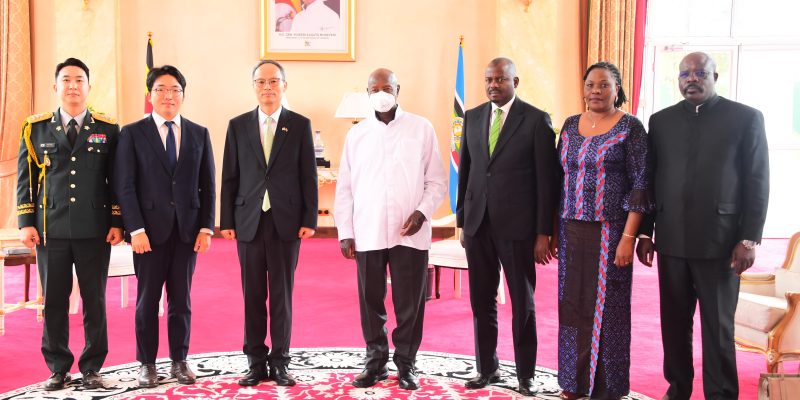
President Museveni later received South Korea’s Ambassador-designate,
Sangho Lee, who conveyed greetings from President Lee Jae Myung and
reaffirmed Seoul’s commitment to strengthening bilateral relations with
Uganda.
Ambassador Lee pledged to deepen cooperation between the two
countries in areas of mutual interest, building on decades of friendly
relations.
President Museveni reflected on Uganda's longstanding relationship with both South Korea and North Korea, noting that Korean professionals have contributed to Uganda’s development for many decades.
“Koreans have been here since 1966. I remember when I was in secondary
school, many Korean doctors came to Uganda. We are very happy with
South Korea, and we have good relations with North Korea as well,”
President Museveni said.
With a smile, the President wondered why the two Korean states had not
reunited into one country despite sharing a common history and culture.
Tanzania and Namibia reaffirm ties:
The President also received Tanzania’s High Commissioner-designate,
Maj. Gen. Marco Elisha Gaguti, and Namibia’s High Commissioner-
designate, Gabriel Pandureni Sinimbo.
The two diplomats pledged to further strengthen the longstanding
friendship and cooperation between their respective countries and Uganda.
President Museveni welcomed the envoys and assured them of Uganda's
support throughout their diplomatic assignments.
He reaffirmed Uganda's commitment to international cooperation, peaceful diplomacy and expanding bilateral partnerships in trade.
The President noted that Uganda remains committed to working closely
with friendly nations in advancing shared development goals and promoting
regional stability.
The presentation of letters of credence is an important diplomatic tradition
through which Ambassadors and High Commissioners formally present
official documents from their respective Heads of State authorizing them to
represent their countries in another sovereign state. The ceremony formally
marks the beginning of their official assignments in the receiving country.
The meetings were attended by the Acting Minister for Foreign Affairs, Hajji
Haruna Kasolo, senior officials from the Ministry of Foreign Affairs, and
other government officials.
What's your reaction?
You may also like

More in:National
Minister Musasizi to MPs: Broaden Tax Base, Don’t Just Tax Same People More to Reach 20% Revenue Target
Minister Musasizi Urgues Parliament to Back Domestic Revenue Drive for Economic Development
Minister Musasizi to URA: Tax Payer is Not the Enemy, Help Small Businesses to Grow
Minister Musasizi: Uganda Must Finance Its Own Transformation, Not Relying on Borrowing and Donors