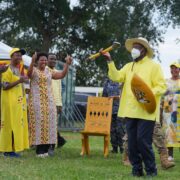
President Yoweri Kaguta Museveni, also the National Resistance
Movement (NRM) Presidential flagbearer, has hailed Uganda’s enduring
peace that has enabled the country to thrive.
“Peace; I am glad to see that what Uganda has enjoyed for the past 40
years is remarkable. In the past, it was different. Today, a child is born,
grows up, studies, finishes school, marries, and has children—all in
peace. Even God said we shall know them by their fruits,” he said.
The President who was accompanied by the First daughter, Mrs.
Natasha Karugire Museveni, made the remarks today during his
campaign rally at Kibiito Secondary School in Bunyangabu District.

President Museveni highlighted how stability has created the foundation
for Uganda’s social and economic growth. Development achievements,
he noted, extend across roads, electricity, telecommunications, water,
railways, and internet access.
“The delay on the Mityana-Mubende-Fort Portal Road was because
resources were scattered and priorities were not clear. Now, our young
cadres have appreciated this, and the road is going to be worked on,” he
said.
Reflecting on education, President Museveni recalled Uganda’s early
post-independence challenges.
“In 1961, we had only six A-level schools—three for boys and three for
girls. Today, Bunyangabu alone has eight government secondary
schools. I feel very happy seeing how far we have come,” he said.

The President also emphasized practical wealth creation, praising
individuals like Mr. George Matongo, a local farmer in Ngoma who
transitioned from subsistence farming to earning income through
commercial modern farming.
On regional trade, President Museveni noted: “As we speak today,
Uganda produces more than five million tonnes of maize per year, yet
consumes only one million tonnes, leaving a surplus of four million
tonnes. If we did not have the East African market, the maize industry
would collapse. The same applies to milk, bananas, beer, cement, and
many other products.
This is why NRM emphasizes regional integration
for economic purposes.”
The President also highlighted success stories from the Presidential
Skilling Hub initiative, which empower local communities.
Ms. Immaculate Kayesu, who dropped out of school due to lack of fees
and early pregnancy, shared her journey.
“I studied at the Kyenjojo Presidential Skilling Hub. With support from the
RDC and PDM funds, I bought pastries worth Shs 600,000, then started
a small chicken farm,” she said.
“Today, I have savings, a bakery shop in Kibiito Town Council, and I
employ one person. I make cakes for prominent schools and clients in
the area,” Kayesu said.
President Museveni hailed such initiatives as proof that skills
development, entrepreneurship, and sustained peace are transforming
lives and fostering wealth creation across Uganda.
The President also handed over the NRM flags to aspiring Members of
Parliament, LC V chairperson, councillors, and other party candidates in
Bunyangabu District, formally endorsing their participation in the
upcoming elections.
On her part, Rt. Hon. Anitah Among, Speaker of Parliament and NRM
second National Vice Chairperson, thanked President Yoweri Kaguta
Museveni for maintaining peace in Bunyangabu, a district bordering the
Democratic Republic of Congo, which has endured instability.
“Your Excellency, thank you for maintaining peace. We should uphold
this by supporting you in the upcoming elections. Let us also thank God
for protecting our President, and we will not allow wicked people to
misguide our people,” said Rt. Hon. Among.
She further acknowledged the government’s commitment to health and
freedom of worship.
“The upgrade of Kibiito Health Centre IV to a district hospital is
underway as part of the National Development Plan. Your Excellency,
we also appreciate the freedom of worship you brought to Uganda,” she
said.
Mr. Hussain Kato, the NRM Party Chairperson for Bunyangabu District,
provided key statistics on the district’s development. Bunyangabu
comprises 15 sub-counties/town councils, 55 parishes, and 338 villages,
with a population of 219,012 (2024 Census).
The Parish Development Model (PDM) has benefitted 17,639
households—about 32% of the district’s 48,988 households—with a total
of Shs 15.08 billion disbursed to 49 of the 55 parishes. The remaining
six parishes were created after the PDM started.
The district also has 18 Emyooga SACCOs with 18,452 members, which
have collectively received Shs 900 million from government support.
On Education, Bunyangabu District has 61 government primary schools
serving 31,810 pupils and eight government secondary schools with
5,925 students enrolled. All eight secondary schools provide Universal
Secondary Education and Universal Post-Ordinary Level Education and
Training.
Currently, 42 of the district’s 55 parishes host at least one government
primary school, while eight sub-counties have at least one secondary
school. Four Seed Secondary Schools are under construction, which will
leave only three sub-counties without a government secondary school.
The President’s initiative to establish skilling hubs in each sub-region
has seen 19 hubs across the country.
The Kyenjojo hub in Toro has already trained 1,169 people, with 238
currently undergoing training in skills such as welding, carpentry,
building, tailoring, hairdressing, bakery, and leather design.
Of Bunyangabu’s 15 sub-counties, one has a Health Centre IV and 12
have Health Centre IIIs. Only two sub-counties currently lack a facility of
HCIII level or above. Planned interventions include upgrading Kahondo
HCII to HCIII in Kisomoro and constructing a new HCIII in Rwimi Sub-
County.
Currently, 205 of the district’s 338 villages (61%) have access to safe
water, while 133 villages (39%) still lack access.
Completed water projects include multiple gravity flow schemes and
piped water systems serving thousands of residents in Rwimi, Kibiito,
Buheesi, Kyamukube, and Rubona, among others. Ongoing
interventions include rehabilitation of eight boreholes and extension of
piped water systems to new communities.
In addition, small-scale irrigation schemes, such as the Kaina Small-
Scale Irrigation covering 15 acres, are operational, while the Rubalika
Solar-Powered Irrigation Scheme is under construction, expanding
agricultural opportunities for local farmers.
Bunyangabu District is now fully connected to the national grid, a
milestone that will support businesses, schools, and households.
The event was attended by NRM Central Executive Committee (CEC)
members, Members of Parliament, religious and cultural leaders, as well
as thousands of supporters.
What's your reaction?
You may also like


More in:National

PRESIDENT MUSEVENI RALLIES KIRUHURA AND KAZO TO EMBRACE PROFITABLE DAIRY FARMING

“BUHWEJU’S LONG- AWAITED ROAD SET FOR CONSTRUCTION,” PRESIDENT MUSEVENI REVEALS

PRESIDENT MUSEVENI PLEDGES COFFEE PROCESSING FACILITY FOR IBANDA, HIGHLIGHTS NRM ACHIEVEMENTS

POLICY ANALYSTS DEMAND BROADER STAKEHOLDER ENGAGEMENT FOR EFFECTIVE POLICY IMPLEMENTATION