President Yoweri Kaguta Museveni, the National Resistance Movement (NRM) Presidential flag bearer, has once again reaffirmed his government’s commitment to delivering free and quality education, consolidating peace, and deepening wealth creation across Uganda.
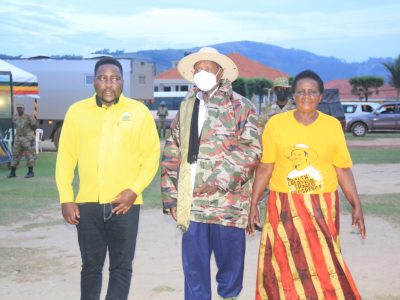
Addressing thousands of jubilant supporters in Pader District, Acholi Sub-region, on Thursday October 23, 2025, during a campaign rally, H.E. Museveni strongly condemned the practice of charging school fees in government schools, equating it to “murder” because it denies children their right to education.
“Charging school fees in government schools is murder and it must stop,” President Museveni declared amid loud cheers from the crowd.

“We started free education, but some people refused to implement it. Now I am going to recruit 50,000 teachers to solve the problem of understaffing and ensure every child studies free of charge,” he added.
The rally was part of President Museveni’s ongoing nationwide campaign trail ahead of the 2026 general elections, as he seeks another mandate to consolidate the NRM’s achievements in peace, development, and wealth creation.
The President expressed disappointment that some headteachers continue to impose illegal charges on parents, pushing many children out of school. He said his next term of office will focus on enforcing genuine free education in all government schools.
President Museveni also highlighted that Pader has made significant progress in education infrastructure.

Pader district boasts 77 government primary schools and 107 private ones, alongside 9 government secondary schools, all offering Universal Secondary Education (USE) and Universal Post-Ordinary Level Education and Training (UPOLET).
“When I see that Pader alone, which is just a small part of the Acholi region, has nine government secondary schools, three of which have A-Level sections, I say Apoyo Lubanga (thank you, God),” the President remarked, recalling his school days at Ntare School, where many of his classmates were from Acholi because at that time there were only six A-Level schools in the whole country.
He revealed that the government is constructing three new seed secondary schools in Pader, which will reduce the number of sub-counties without a government secondary school from 14 to 11.
President Museveni further explained that because free education has not been fully implemented, many children drop out and miss opportunities, a gap the NRM government has sought to fill through the Presidential Industrial Skilling Hubs, now established in all regions of Uganda.
“I started 19 skilling hubs to teach vocational skills for free. After six months, students can make furniture, shoes, clothes, and metallic doors. Many are already creating jobs,” he said, visibly impressed after buying a pair of shoes made by 18-year-old Okol Jonathan, a student of the Gulu Presidential Industrial Skilling Hub, for UGX 500,000.
He added that the maintenance of these hubs is costly because the government provides accommodation and meals for trainees, underscoring how free education would reduce such expenses by keeping children in regular schools.
President Museveni reminded the people of Pader that the peace they enjoy today was not by accident, but a result of NRM’s deliberate political strategy and strong national institutions.
“In the last 40 years, we have been able to bring peace to Uganda. You people of Pader are witnesses because you saw the wars-from Kabalega’s resistance to the wars of Idi Amin, Obote, and even the LRA insurgency. But now, all that is behind us,” he said.
President Museveni further explained that before 1986, Uganda’s politics was sectarian, divided along religious and tribal lines, which weakened parties and fueled instability.
“In 1962, no party got 50% of the vote because politics was based on religion and tribe. UPC had to form a coalition with Kabaka Yekka which collapsed in two years. NRM built a national, non-sectarian political movement that unites Ugandans regardless of tribe or religion, that’s why we have lasting peace,” President Museveni emphasized.
He noted that NRM’s good politics has built strong national institutions such as the Uganda People’s Defence Forces (UPDF), Police, and Intelligence Services, all of which maintain peace and security nationwide.
“When we talk of peace, we have proof,” President Museveni said, adding that unity and prioritization have guided NRM’s leadership.
“I have lived 55 years as a soldier without a good salary because we prioritized weapons and defense first,” he said.
The President emphasized the importance of prioritizing key sectors such as defence, roads, electricity, education, and health — before addressing less urgent demands like administrative expenditures and new districts.
“If we try to do everything at once, we end up with half-baked work. Prioritization is key,” President Museveni said, citing several major road projects in Northern Uganda such as Karuma–Gulu–Atiak–Nimule and Oluo–Kitgum, and assured that with continued prioritization, Pader’s roads will be worked on one by one.
The President also expressed satisfaction with the ongoing extension of electricity distribution in Northern Uganda, urging local leaders to monitor quality and maintenance of roads.
“If it’s a tarmac road, maintain it as tarmac. Marrum roads must also be graded properly with drainage channels, not like swimming pools when it rains,” he cautioned road engineers.
On water access, President Museveni praised Pader’s progress, with 770 out of 871 villages having access to safe water — a coverage of 88%. Several piped water systems managed by the National Water and Sewerage Corporation (NWSC) and the Umbrella of Water and Sanitation North are already operational in Pajule, Pader Town, Lacekocot, Puranga, Aweere, and Corner Kilak.
“In the next term (Kisanja), we shall ensure piped water reaches every village,” the President pledged.
Healthcare expansion in Pader:
President Museveni noted that out of 23 sub-counties in Pader, only one has a Health Centre IV, while 13 have Health Centre IIIs. He announced plans to ensure every sub-county gets at least a HCIII or HCIV, with a district hospital also in the pipeline.
Ongoing and planned projects include: the construction of new HCIIIs at Tenam and Pukor, upgrading Lutanya, Oryang, Latigi, Amilobo, Lawire, and Paiula HCIIs to HCIIIs, construction of new Outpatient Departments at Tenam and Pukor, and a Medicine Store at Pajule HCIV.
“In the coming Kisanja, every sub-county will have a health centre, including a district hospital,” President Museveni assured the crowd.
Cattle compensation:
Addressing the long-standing issue of cattle compensation in Northern Uganda, President Museveni appreciated local leaders for supporting his new compensation model, which he said was fairer and more manageable.
“When I checked, the government had allocated UGX 59 billion for compensation. I suggested a flat rate of five cows per household, a fair and equal method,” he said, further explaining that this program will help revitalize livelihoods and complement other poverty reduction initiatives such as the Parish Development Model (PDM).
The President urged Ugandans to understand the difference between development (public infrastructure) and wealth creation (personal income).
“We have roads, schools, and hospitals, but you don’t sleep there. You sleep in your house. So, development is ours, but wealth is mine, my family’s, or my company’s,” he said, encouraging Pader residents to embrace modern commercial agriculture and other income-generating activities supported by government programs like PDM.
Pader has 95 parishes, and under PDM, it has received UGX 29.17 billion, of which UGX 28.8 billion (98.7%) has been disbursed to 28,844 beneficiary households.
With 52,627 total households in the district, 54% have already benefited, leaving 23,783 households yet to receive funds.
President Museveni promised that all will benefit in the next phase.
“We are adding a special fund for religious leaders, another for university graduates who fail to get jobs, and 15 million shillings for local leaders,” he announced.
The President screened a video of George Matongo, a livestock farmer from Nakaseke, who produces 900 litres of milk daily and earns UGX 29 million a month despite limited education.
“If Matongo can prosper without a tarmac road, what excuse do you have?” President Museveni challenged the crowd, reinforcing his message of self-reliance and household wealth creation.
President Museveni urged the people of Pader and Acholi sub-region to consolidate the gains of peace and development by voting NRM.
“NRM is the only party that can show you what it has done and what it will continue to do. We brought peace, we are building the economy, and we are creating wealth. Do not be misled by those who only talk,” President Museveni said.
The NRM chairperson for Pader, Hon. Lowila C.D. Oketa hailed President Museveni for empowering women across all levels of leadership, citing that the Vice President, Speaker of Parliament, Prime Minister, and herself as Pader NRM Chairperson are all women.
“Our people appreciate you for championing women emancipation and leadership,” she said.
She further thanked the President for ending the insurgency in Northern Uganda and promoting peace, which has enabled communities to rebuild their lives and join government programs like PDM.
The event was graced by several senior leaders, including the Government Chief Whip Hon. Denis Hamson Obua, who described a vote for President Museveni as “a vote for sustainable peace and household income.”
Pader’s support for candidate Museveni:
Statistics show that the district has consistently voted overwhelmingly for President Museveni. In the 2021 elections, out of 82,298 registered voters, 47,623 (58.9%) turned up to vote, and President Museveni polled 28,233 votes (63.6%), far ahead of his competitors.
For 2025, the district now has 99,041 registered voters, up from 82,298 in 2021 — an increase of 16,743 new voters and 268 polling stations (up from 215).
“In 2021, we gave President Museveni 63.6%. This time, we are aiming for 80%,” declared Hon. Lowila, as the crowd chanted in agreement.
What's your reaction?
You may also like
More in:National
PRESIDENT MUSEVENI URGES EUROPEAN INVESTORS TO TAP INTO UGANDA’S ECONOMIC OPPORTUNITIES
Tayebwa Issues Stern Warning to Ineffective Parliamentary Committees
Minister Babalanda Urges Ugandans in Diaspora to Invest at Home and Champion Uganda’s Global Image