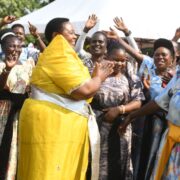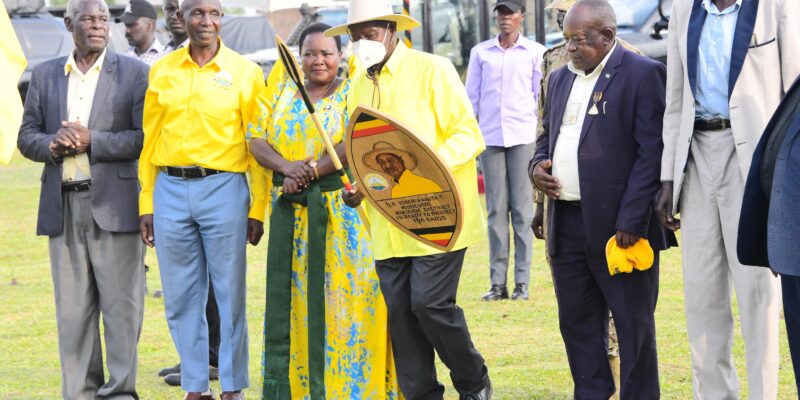
President Yoweri Kaguta Museveni, on Saturday, December 13, 2025,
used his campaign rally in Kikuube District to confront the contentious
issue of fisheries management on Lake Albert, while at the same time
advancing his broader 2026 campaign message centering on peace,
wealth creation, and consolidation of the National Resistance
Movement’s (NRM) development record.
Addressing thousands of supporters at Kiziranfumbi Primary School
Playground, the President struck a balance between acknowledging
grievances raised by fishing communities and defending the long-
standing policy measures his government introduced to rescue Uganda’s
depleted fish stocks.
“The issue about the fisheries is first of all to stop bad fishing — catching
young fish — and secondly attacking the fish breeding parts of the lake.
You have to stop catching young fish and also don’t go to fish breeding
areas,” he said.
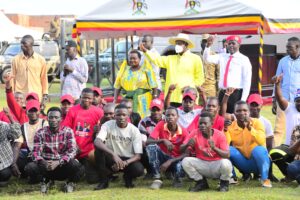
Earlier in the day, Speaker of Parliament and Second National Vice
Chairperson of the NRM, Rt. Hon. Annet Anita Among, briefed the
President on complaints from local leaders and fishing communities over
alleged harassment by security forces enforcing fisheries regulations on
Lake Albert.
“The people of Kikuube are complaining about the harassment of the
fishermen on Lake Albert by the army. This needs your intervention,” she
informed the President, drawing applause from sections of the crowd.
President Museveni responded by reiterating that regulation of fishing
activities was unavoidable if the lake was to remain productive but
conceded that enforcement must be guided by consultation and fairness.
“Even if you’re fishing well, there must be a limit to the number who are
allowed to fish in the lake,” he said. “Even Namboole Stadium has a
limit. Not everybody who pays is allowed to go there; otherwise, people
will die.”
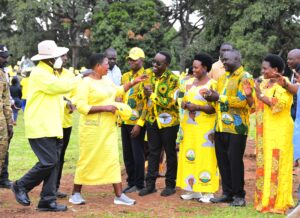
Kikuube District, which borders Lake Albert, relies heavily on fishing as a
source of employment, food, and household income, particularly in
lakeshore sub-counties. While agriculture remains the dominant
economic activity overall, fishing supports thousands of families and
fuels cross-border trade with the Democratic Republic of Congo.
President Museveni leaned heavily on cultural analogies and indigenous
knowledge systems to justify conservation measures, arguing that
responsible fishing is not a foreign imposition but a principle long
understood by traditional communities.
“That’s why we’re discussing it with our elders,” he said. “There are clans
like those in Pakwach and in Buliisa, called Abakwanga, who have
traditional fishing knowledge. For them, if they catch a young fish, they
put it back into the lake because they know that without it, fish will be
depleted.”
He likened illegal fishing practices to taboos observed in pastoral
communities.
“Even me, a traditional cattle keeper, don't eat calves,” President
Museveni said. “It is taboo to eat a calf among the cattle keepers.
Likewise, it is not logical for you to catch and eat premature fish.”
In 2017 the government deployed the Uganda People’s Defence Forces
(UPDF) Fisheries Protection Unit to curb illegal fishing that had
devastated fish stocks across the country’s lakes. The unit is now under
the supervision of Lt. Col. Mercy Tukahirwa.
To ease pressure on Lake Albert and provide alternative livelihoods,
President Museveni again promoted commercial fish farming as a viable
and lucrative option, especially for communities living near swamps and
other water bodies.
He cited his own Baralege model farm in the Lira–Lango sub-region as
proof of concept. On the four-acre farm, President Museveni practices
integrated agriculture, combining dairy cattle under zero-grazing, fish
farming, coffee, fruits, and bananas.
“From my fishpond of 20 metres by 100, I get 100 million shillings per
year,” he said. “After removing costs, I am left with 70 million. You can
have two such ponds on one acre, and that will be 140 million shillings.
You can imagine.”
According to the President, structured consultations with elders and local
leaders will help determine who should fish on the lake, how many
people can sustainably do so, and how surplus labour can be redirected
into aquaculture.
“That’s why we need to discuss with the elders to establish who should
be in the lake, why, and how many of them,” he said. “Then, with the
surplus, we can make arrangements for them to begin commercial fish
farming.”
The NRM presidential candidate also used the Kikuube rally as a
platform to popularise the NRM’s 2026–2031 manifesto, which he said
builds on seven historic contributions of the party to Uganda’s
transformation. Chief among them, he argued, is peace.
“You’re all children and grandchildren of freedom fighters,” President
Museveni told the crowd. “These areas of Buhimba, Masindi, and
Birembo is where we fought. There were wars. Now the whole of
Uganda is in total peace.”
On development, President Museveni highlighted gains in electricity
connectivity, water provision, and health services in Kikuube District.
“Kikuube is one of the few districts where almost all the sub-counties
have electricity up to the district headquarters,” he said. “19 sub-counties
have electricity up to the headquarters. This is good.”
However, challenges remain. Out of 335 rural villages in the district, only
192 have access to safe water sources, representing coverage of 57 per
cent, leaving 143 villages without clean water.
President Museveni acknowledged the gap and pledged increased
investment in water infrastructure.
“Much has been done, but more will be done to increase access to clean
water across the district,” he said.
On health, the President welcomed information that all 19 sub-counties
now have either a Health Centre IV or Health Centre III.
“We’re going to upgrade Kikuube Health Centre IV to a district hospital,”
he announced, drawing cheers from local leaders and residents.
Reiterating a theme that has defined his recent campaign rallies,
President Museveni emphasised wealth creation at the household level
as the third pillar of the NRM’s contribution, alongside peace and
development.
“Since 1986, when we came into government, we have been telling you
about wealth creation and household income at the individual and family
level,” he said.
To illustrate the model, the President showcased several high-
performing demonstration farms across the country. One of them is the
Kamanyire Demonstration Farm in Kakumiro District, owned by State
Minister for Transport Fred Byamukama.
According to President Museveni, the four-acre model farm runs multiple
enterprises — coffee, bananas, pineapples, poultry, dairy and piggery —
and currently keeps more than 200 pigs and over 25,000 layers
producing about 300 trays of eggs daily. The farm also has eight dairy
cows producing approximately 120 litres of milk every day.
“This boy, Byamukama, just started yesterday, but he is using four acres
to create wealth for himself and others,” he remarked.
President Museveni also cited examples from regions often associated
with poverty and underdevelopment to underscore his argument that
wealth creation depends more on enterprise selection than on
infrastructure alone.
He pointed to Korea Dick Ogira, a model farmer in Abim District,
Karamoja sub-region, who received 200 mango seedlings from
Operation Wealth Creation (OWC) and Shs1 million under the Parish
Development Model (PDM).
Ogira planted two acres of cassava alongside the mangoes and,
according to President Museveni, he earned Shs 12 million in the first
year by selling mangoes at Shs 1,000 each.
“Next year I expect to get Shs18 million in the harvest, and in a year I
expect to get 32 million shillings after two harvests,” Ogira said in a
video display.
“That man is in Abim, Karamoja, where there’s no tarmac road, but he’s
creating wealth,” the President added.
“Development is not there, but wealth is there. That’s why we have been
telling you to differentiate between development and wealth creation.”
Another success story highlighted was that of Johnson Basangwa, a
major poultry farmer whose operation employs more than 300 workers
and earns an estimated Shs20 million per day from egg sales.
“That man and others were fighting over an LC-5 position. I told them
you can’t all be LC-5 chairman. Among the seven activities, he picked
poultry and now has 110,000 birds. He is now out of poverty.”
The President stressed that in developed economies, jobs come
primarily from commercial agriculture, manufacturing, artisanship,
services, and ICT not from government employment.
He cited industrial parks such as Sino–Mbale, which employs about
12,000 workers, and Namanve, which hosts 273 factories employing
more than 24,000 people, as evidence of the NRM’s commitment to
industrialisation.
President Museveni cautioned small landholders against enterprises that
yield low returns on small plots.
“Extensive agriculture is for those with big land,” he said. “If you have
one acre and plant tea, you will never get out of poverty. If you have one
acre, you must be very careful.”
He argued that crops such as maize, sugarcane, and cocoa are more
profitable when grown on large tracts of land, reinforcing his message
that enterprise choice must match land size.
Kikuube District NRM Chairman Kazini Francis thanked the President for
programmes such as PDM and Emyooga, improvements in education,
and for granting Kikuube district status after it was carved out of Hoima.
He appealed to President Museveni to prioritise the elevation of Kikuube
Health Centre IV to district hospital status, noting that the district
currently lacks a hospital. He also requested a ferry on Lake Albert to
ease transport and trade between Uganda and the Democratic Republic
of Congo.
President Museveni, who is both the NRM National Chairperson and the
party’s presidential candidate for the 2026 elections, is scheduled to
conclude his Bunyoro sub-region campaign rallies on Monday,
December 15, 2025, with a final stop in Kakumiro District.
He will thereafter launch campaign tours in the Buganda region,
beginning with a mega rally in Mubende District.
What's your reaction?
You may also like
More in:National
Why LC1 elections matter more than voters realize after years of delays
STATE HOUSE LAUNCHES STRATEGIC DEVELOPMENT PLAN, SERVICE DELIVERY STANDARDS AND CLIENT CHARTER
BRIAN MUSHANA KWESIGA: From Fear to Opportunity: Rethinking Uganda’s Dual Citizenship Laws
SKILLS MEET SPORTS AT PRESIDENTIAL SKILLING INITIATIVE SHOWCASE EVENT