Uganda has taken a bold step towards printing its own currency locally after the signing of a Memorandum of Understanding between the Uganda Security Printing Company (USPC) and German-based global currency printing giant, K&B Banknote Solutions.
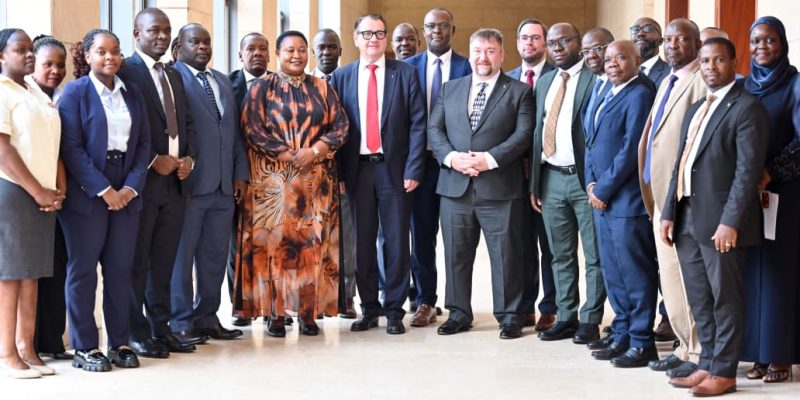
The signing ceremony was presided over and witnessed by the Minister for the Presidency and MP for Budiope West, Hon. Babirye Milly Babalanda, held at the Office of the President, Minister’s Board Room. The event was attended by the Permanent Secretary, Ministry of the Presidency, the Board Chairpersons of UPPC and USPC, the Managing Directors of USPC and UPPC, and the delegation from K&B Banknote Solutions.
In her remarks, Hon. Babalanda said although the ceremony was simple, what is being done is very important for the sustainability of the country.
“I warmly welcome our partners from K&B Banknote Solutions to Uganda. We are pleased to start on our journey on the collaboration for the establishment of a currency printing facility in Uganda,” the Minister said.
She said the MoU provides a framework for the technical, security, feasibility and commercial work that will guide Uganda towards final establishment of the printing plant.
“As we begin on this journey, the question before us is simple: Can Uganda establish and operate a modern currency facility that can meet the national and regional currency demands? If the answer is yes, then what does it require us to do and how long does it take to have the facility up and running?” she tasked the technical teams.
Minister Babalanda said the project directly supports the long-standing vision of H.E. President Gen. Yoweri Kaguta Museveni, based on three important principles:
1) National Sovereignty: Uganda should have the ability to produce important instruments of the State locally, including currency, passports, national identity cards, and academic certificates.
2) Value Addition: Uganda must use its labour, skills and other resources to produce more high-value goods and services locally instead of depending on imported finished products.
3) Capacity Building: Uganda must give its young people, engineers and technicians opportunities to acquire modern skills and work with advanced security-printing technology.
“This is why I want to emphasise that we are not simply installing machines. We are building a national capability,” Hon. Babalanda stressed.
The Minister emphasized that as Government moves towards the final agreement with K&B Banknote Solutions, government expects skills transfer must be a central part of the partnership.
“Our Ugandan engineers and technicians must be involved from the beginning. They should work alongside specialists during the planning, installation, testing and commissioning, and gain the practical skills needed to operate and maintain the facility,” she directed.
“I am glad to have learnt that K&B has an academy that imparts technical skills to the youths that operate their machines. I therefore look forward to seeing that moment when Ugandans will be tapping into this opportunity.”
Minister Babalanda noted the project is fully aligned with Uganda’s development priorities:-
a). The NRM Manifesto 2026-2031 which places strong emphasis on industrialisation, production and economic transformation. Local security printing supports this as a high-technology, skills-intensive manufacturing activity.
b). The Fourth National Development Plan (NDP IV), particularly its focus on sustainable industrialisation, employment, wealth creation, science, technology and innovation.
c). Uganda Vision 2040, which seeks to transform Uganda into a modern and prosperous country by building strong industrial and technological capabilities.
“For this reason, I consider this project an important part of Uganda’s wider industrialisation and technological development agenda,” she said.
On governance, the Minister ordered for strong coordination, monitoring and accountability.
“I expect my office and USPC to establish a multi-sectoral technical committee that brings together key stakeholders, including the Bank of Uganda, the Ministry of Finance, Planning and Economic Development, the Attorney General’s Chambers, and the relevant security agencies,” she said.
“We must also establish a formal monitoring arrangement to ensure that progress is regularly measured against the agreed roadmap milestones. Please, note that of late H.E the President is tired of hearing projects that have failed to take off and those that have delayed to be completed.”
In a firm warning, Minister Babalanda said: “For this matter, as your political supervisor, I want to assure you that I will not tolerate any actions that are likely to drag the implementation of this project. Note that I have a name to protect before the appointing authority.”
“My office is always open for you to seek any guidance and support. I will take it upon myself to mobilise my senior colleagues and any other relevant stakeholders to ensure that this project becomes a success, before I leave this office.”
She emphasized integrity: “This is a strategic national facility that will be involved in currency manufacture. Therefore, procurement must be clean, timelines must be realistic and respected, and accountability must be maintained throughout the project cycle. There must be no room for unnecessary delays or actions that undermine the national interest.”
In conclusion, Minister Babalanda appealed to the K&B team to share their technical know-how with the USPC team to ensure Joint Venture objectives are realised in a timely manner and to support USPC to access cheaper financial sources to fast-track implementation.
“From my personal experience, I have seen investors who have disguised themselves to be genuine but they end up duping the country. However, for your case, I have a strong belief that you are not under that category. The visit and interactions which I have had with you have evidently demonstrated that you are a serious and committed partner to work with. The global image that you have in the area of currency equipment manufacturing cannot be doubted by any person. Please work with the team to uphold your international reputation,” she told K&B.
To USPC, she said: “Please remain focused on the objectives of the joint venture agreement. In whatever you do, please, do it in the good spirit of the country.”
She demanded a detailed roadmap for execution: “The moment I receive it, I will secure an appointment with H.E the President so that we can appraise him about the status of this project.”
Hajji Sadat Kisuyi on behalf of the Permanent Secretary Office of the President, welcomed the delegation of K&B Banknote Solutions to Uganda and ensured them a strong working partnership and oversight role in monitoring the project.
The signing of the MoU paves way for feasibility studies and commercial negotiations that will lead to the establishment of Uganda’s first ever sovereign currency printing facility, which will also serve regional demands.
What's your reaction?
You may also like
More in:Business
PRESIDENT MUSEVENI URGES EUROPEAN INVESTORS TO TAP INTO UGANDA’S ECONOMIC OPPORTUNITIES

From the Lab to Your Bathroom Shelf: Why I’m Proud to Sell UBeauty
Minister Babalanda Calls for Financing Architecture to Match Uganda’s US$500 Billion Growth Ambition by 2040
PRESIDENT MUSEVENI COMMENDED FOR SKILLING INITIATIVE AS STATE HOUSE ANNOUNCES NEW HUB IN BUSOGA