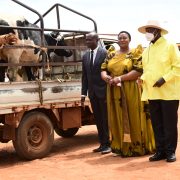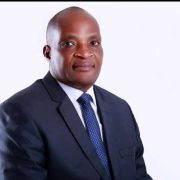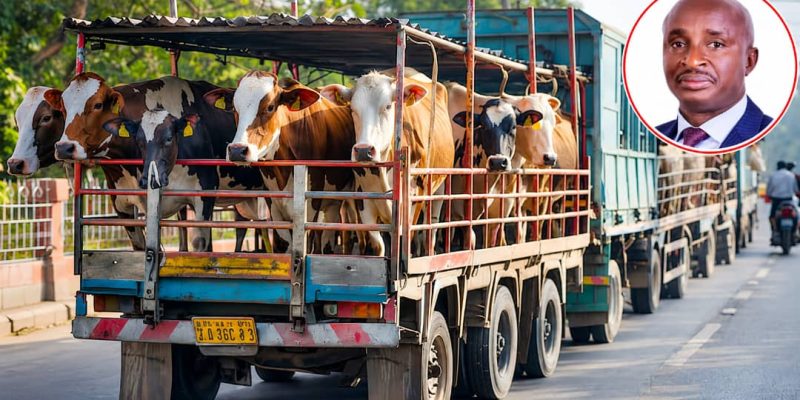
What was supposed to be a routine movement of cattle from the farm of the late Moses Kalangwa has instead become the latest flashpoint in a widening dispute over his estate, pitting members of his family against each other and raising questions about who has authority to make decisions concerning the deceased’s property.
The dispute came into public view after Kalangwa’s eldest daughter, Jackline Kobusingye Birungi, intercepted cattle that were being transported away from one of her late father’s farms.
Birungi recorded the incident and later shared footage on social media, where she accused her stepmother, Florence Joyce Kirabo, Kalangwa’s widow and official wife, of attempting to remove the cattle from the family farm without informing the children.
The accusations have added a new layer to an already complicated disagreement over Kalangwa’s estate, with the cattle now at the centre of competing claims about their ownership, management and intended destination.
But the events surrounding the cattle movement tell a story that goes beyond the confrontation captured on camera.
Information obtained by this website indicates that the cattle were being moved from Kalangwa’s farm after concerns emerged over the increasingly complicated situation surrounding the land on which the animals had been kept.
Kirabo’s position is that the decision was not an attempt to secretly dispose of the cattle or personally benefit from them, but rather an effort to safeguard the animals by moving them to another piece of land that was not affected by the disputes surrounding the farm.
The transfer was already underway when Birungi reportedly intercepted the people transporting the cattle.
The intervention stopped the movement and turned what had initially been a livestock transfer into a confrontation over who had the authority to determine where the animals should be kept.
Birungi subsequently presented the incident on social media as evidence of an attempt to remove or sell part of the family property without the knowledge of the children.
Kirabo, however, disputes that interpretation.
According to her position, the decision to move the cattle was driven by the circumstances at the farm, particularly the continuing contestation over the land and concerns about the welfare and security of the animals.
The disagreement therefore goes to a fundamental question in the administration of Kalangwa’s estate: who has the authority to make decisions concerning the cattle while the wider estate remains subject to disagreements among family members?
The answer is complicated by the history of the farm itself.
Before his death, Kalangwa established the farm on land situated in Misanga Village in Bbaale County, Kayunga District.
He acquired the land from Jesca Abaho, who was acting as administrator of the estate of the late Richard Mushabe.
The transaction later became the subject of a court challenge by Jinepher Nsubuga and others, creating an additional layer of uncertainty around the property on which Kalangwa’s farm was operating.
As the contest over the land continued, questions emerged about the continued use of the property and the implications for the livestock kept there.
Following Kalangwa’s death, the circumstances surrounding the farm became even more complicated as disagreements over his estate emerged among members of the family.
The cattle, therefore, were not merely being moved from one farm to another.
They had become part of an estate whose administration was already under strain and whose assets were being viewed through the competing interests of family members.
This helps explain why their movement triggered such a strong reaction.
For Birungi, the interception appears to have been about preventing the removal of what she considered family property without adequate consultation.
For Kirabo, the circumstances were different: the animals needed to be moved away from a farm affected by a continuing land dispute and placed somewhere where they could be better protected and managed.
The social media footage, however, captures only the final stage of the disagreement.
It shows the confrontation surrounding the cattle but does not by itself establish the circumstances that led to their movement, the ownership arrangements governing the animals or the authority under which the transfer was initiated.
Those questions are linked to the broader dispute over Kalangwa’s estate and, in particular, the interpretation and implementation of his will.
Kalangwa left a will setting out his wishes concerning his property and estate. However, disagreements among members of his family have complicated the process of implementing those wishes.
The dispute over the cattle is therefore only one part of a much larger disagreement over the administration of Kalangwa’s estate.
The latest incident has nonetheless placed the livestock at the centre of the dispute.
The key issue is no longer simply where the cattle were being taken, but who was authorised to make that decision, why the transfer was considered necessary and whether the interests of the estate’s beneficiaries were adequately taken into account.
Those questions are unlikely to be answered by social media accusations alone.
They require the wider circumstances surrounding Kalangwa’s farm, the contested land, the management of his estate and the provisions of his will to be considered together.
For now, the cattle remain a visible symbol of the deeper disagreement surrounding the late Kalangwa’s property.
What began as an attempted transfer of livestock has exposed unresolved questions over control, management and the implementation of the deceased’s wishes, ensuring that the cattle remain at the centre of the Kalangwa family dispute
What's your reaction?
You may also like



More in:Business

SWEDEN EYES UGANDA ENERGY, TRANSPORT INVESTMENT OPPORTUNITIES AS COL. NAKALEMA ASSURES INVESTORS OF PROTECTION
AL-HAJJ FARUK KIRUNDA: President Museveni did the right thing on Constitutional Square
Minister Babalanda Hails Reformed Buwenge Youth Group

Minister Babalanda Urges Ugandans in the Diaspora to Invest Skills and Capital Back Home