President Yoweri Kaguta Museveni has called for increased Japanese
investment in Uganda, particularly in agro-processing, and urged Japan to
support the country with road construction equipment to accelerate
infrastructure development.
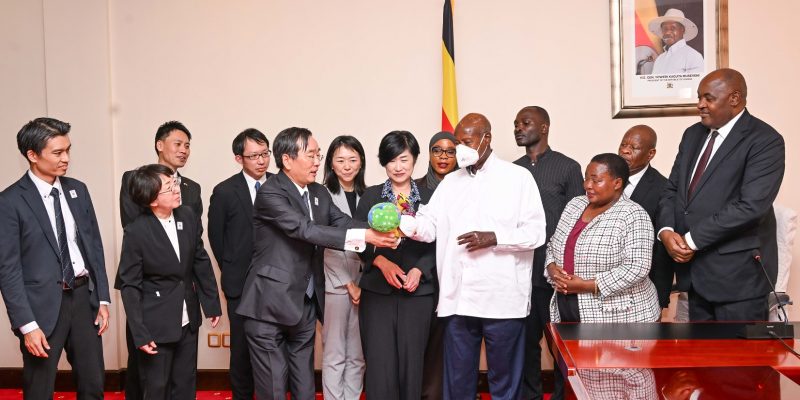
The President made the call today during a meeting with a Japanese
delegation led by Ambassador Takahashi Misako, Director General and
Assistant Minister for the African Affairs Department at Japan’s Ministry of
Foreign Affairs, at State House, Entebbe.
The discussions focused on strengthening Uganda-Japan bilateral
cooperation in infrastructure, energy, investment, education, health, youth
development and other areas of mutual interest.
President Museveni commended Japan for its support to Uganda’s
infrastructure development, citing projects such as the Kampala Flyover
and Karuma Bridge.
“Thank you for the support like the flyover and Karuma Bridge,” President
Museveni said.
He said Uganda requires more road construction equipment to support
road works across the country and proposed that each local government
should have its own machinery rather than relying on shared equipment.
“I want each to have its own road equipment, the big ones, so that they
don’t have shared equipment,” he said.
The President said the equipment could include graders, trucks,
compactors and other earth-moving machinery, adding that the machinery
does not necessarily have to be new provided it is durable and can be
repaired and maintained locally.
President Museveni noted that Uganda had previously purchased road
construction equipment from Japanese companies, including Komatsu, and
expressed interest in acquiring more machinery.
He also requested a meeting with Japanese companies operating in
Uganda to discuss challenges affecting their businesses and explore ways
of strengthening their operations.
“I would want to meet them as a group, if we could organize. They come
here and they tell me the issues they have, so that I can solve them,” he
said.
The President further called for increased Japanese investment in agro-
processing, saying value addition would create jobs, expand economic
opportunities and contribute to Uganda’s economic growth.
He said Uganda supports wealth creation both domestically and globally
because a stronger global economy creates markets for products from
different countries.
The Japanese delegation said Japan would continue supporting Uganda’s
development through infrastructure projects, human resource development,
education, health and refugee support.
Ambassador Misako said Japan was considering additional support for the
Kampala Flyover and road upgrading projects and was also exploring
possible support for the improvement of the Kibuye-Busega road.
On the reconstruction of Karuma Bridge, the Ambassador said a
groundbreaking ceremony was planned for November and expressed hope
that President Museveni would attend, subject to his schedule.
“We would also very much like President Museveni to attend this ceremony
if the schedule allows,” she said.
The Ambassador said Japan remained committed to supporting Uganda’s
efforts to improve the welfare of refugees and host communities.
“Uganda accepts the largest number of refugees in Africa,” she said,
adding that Japan would continue supporting Uganda in addressing the
needs of refugees and host communities.
She also commended Uganda’s contribution to regional peace and stability,
particularly its deployment of troops to Somalia and the Democratic
Republic of Congo.
The Ambassador recalled Japan’s support to Uganda during the Ebola
outbreak and commended the Government and people of Uganda for their
response to the epidemic.
On trade and investment, she said 17 Japanese companies currently have
bases in Uganda, operating in sectors including transport, health,
manufacturing and agriculture.
She applauded President Museveni for creating an environment that
enables Japanese companies to operate in Uganda, stressing the
importance of maintaining a conducive business climate.
“Ensuring a free and fair business environment is extremely important for
promoting foreign investment and further advancing Uganda’s economic
development,” she said.
The Ambassador said Japan would like to see more Japanese companies
invest in Uganda and called for continued cooperation between the two
countries to strengthen trade and investment ties.
The meeting also discussed education and youth development. The
Ambassador said more than 200 Ugandans had studied in Japan under
Japanese Government scholarship programmes, while more than 4,000
Ugandans had travelled to Japan through various Japan International
Cooperation Agency (JICA) training programmes.
She added that 846 JICA Overseas Cooperation Volunteers had so far
been deployed to Uganda, with 37 currently working in different parts of the
country.
The Ambassador also highlighted the role of the Tokyo International
Conference on African Development (TICAD) in strengthening Japan-Africa
relations, noting that Uganda has been a constructive partner since the first
TICAD meeting in 1993.
What's your reaction?
You may also like
More in:Business
PRESIDENT MUSEVENI COMMISSIONS MBALE ZOO, URGES UGANDANS TO TAP INTO GLOBAL TOURISM MARKET

SWEDEN EYES UGANDA ENERGY, TRANSPORT INVESTMENT OPPORTUNITIES AS COL. NAKALEMA ASSURES INVESTORS OF PROTECTION
AL-HAJJ FARUK KIRUNDA: President Museveni did the right thing on Constitutional Square
Minister Babalanda Hails Reformed Buwenge Youth Group