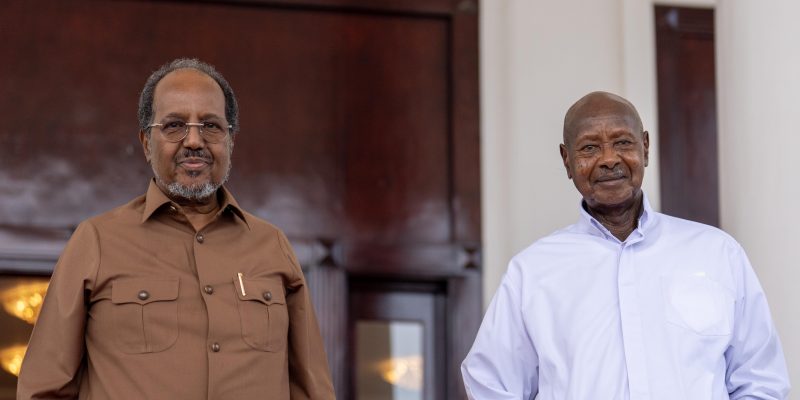
President Yoweri Kaguta Museveni has urged Somali leaders and citizens
to unite in the fight against Al-Shabaab, arguing that ideological divisions
and failure to correctly identify the country’s challenges have undermined
efforts to achieve lasting peace and stability.
President Museveni made the remarks on Monday, October 26, 2026, while
meeting the President of the Federal Republic of Somalia, Hassan Sheikh
Mohamud at State House, Entebbe, during an official visit to Uganda.
The discussions focused on Somalia’s security situation, particularly efforts
to defeat the Al-Shabaab insurgency, as well as strengthening bilateral
trade and economic cooperation between the two countries.
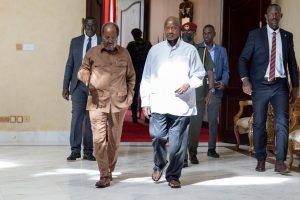
President Museveni said Somalia’s challenges required a clear
understanding of their underlying causes and a united approach, warning
that divisions among the majority could allow a minority to maintain
influence.
“The problem of Somalia is ideological and a misdiagnosis of problems,”
President Museveni said, drawing parallels with other African countries,
including Sudan, where sectarian approaches to governance have
contributed to political divisions and exclusion.
“All the problems you’re talking about, we know them. We need to be
organised and stand with the main problem,” he said.
“Unite the many to defeat the few, but some Africans want to annoy the
many to stay with the few,” he added.
The President emphasised the need for political organisation and unity in
confronting the challenges threatening Somalia’s stability.
During the meeting, H.E Mohamud briefed President Museveni on the
security situation in Somalia and commended the contribution of the
Uganda People’s Defence Forces (UPDF) to efforts to restore peace.
Ugandan troops have played a significant role in African Union-led peace
support operations in Somalia, supporting Somali security forces in
confronting Al-Shabaab militants.
H.E Mohamud also thanked President Museveni for Uganda’s continued
military contribution and support, expressing hope that Ugandan troops
would remain in Somalia longer to help achieve full pacification and lasting
stability.
Al-Shabaab continues to pose a major security challenge in Somalia and
the wider Horn of Africa, with regional and international partners supporting
efforts to strengthen Somali security institutions and combat the insurgency.
The Somali President also appreciated Uganda’s hospitality towards
Somali nationals living, studying and conducting business in the country.
Somalia’s Ambassador to Uganda, Fardowsa Mohamed Qanyare, informed
the meeting that approximately 8,000 Somalis operate businesses in
Uganda, while about 15,000 Somali students are pursuing studies at
Ugandan universities.
Uganda eyes direct coffee exports to Somalia:
The two leaders also discussed ways to expand bilateral trade, with
particular emphasis on improving direct access for Ugandan products to
the Somali market.
President Museveni welcomed the development that Somalia had
permitted Uganda to establish a warehouse in the country through which
processed Ugandan coffee would be marketed and sold.
The proposed arrangement is expected to create a more direct route for
Ugandan coffee exporters to reach Somali consumers, potentially reducing
reliance on intermediaries and strengthening commercial ties between the
two countries.
Mr. Nelson Tugume, who recently returned from Somalia, told the two
Presidents that Somalia imports coffee from European countries, with
Ugandan coffee reportedly passing through other markets before reaching
Somali consumers.
The warehouse initiative could therefore provide Ugandan exporters with a
more direct channel into Somalia’s market while expanding opportunities
for trade and investment.
The discussions reflect efforts by the two governments to complement
security cooperation with economic partnerships that can strengthen
bilateral relations and create new market opportunities.
The meeting was attended by the Minister of State for Foreign Affairs, Hon.
Haruna Kasolo; the Minister of State for Defence and Veteran Affairs, Hon.
Huda Abason Oleru; the Permanent Secretary- Ministry of Foreign Affairs,
Mr. Vincent Bagiire; and Uganda’s Ambassador to Somalia, Prof. Sam
Tulya-Muhika.
What's your reaction?
You may also like
More in:National
Take Parliament to the People, Tayebwa Advise MPs
Minister Babalanda Warns Basoga Against Land Fragmentation, Urges Families to Embrace Wealth-Creation
PRESIDENT MUSEVENI URGES EUROPEAN INVESTORS TO TAP INTO UGANDA’S ECONOMIC OPPORTUNITIES