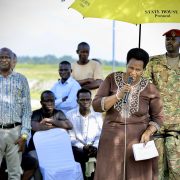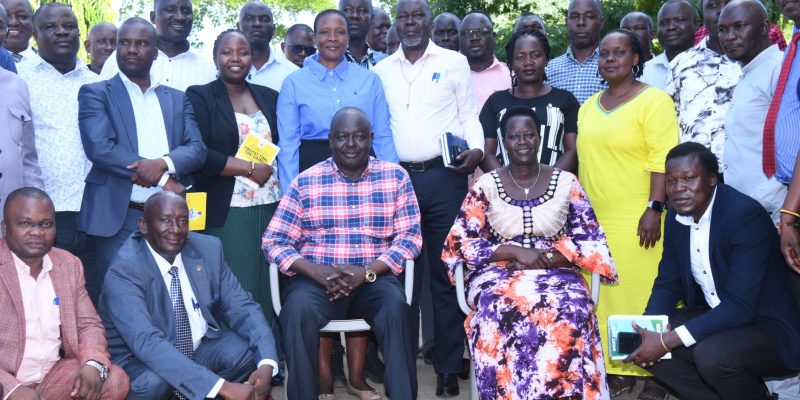
SOROTI CITY – The Minister for the Presidency, Hon. Milly Babirye Babalanda, has challenged Resident District Commissioners (RDCs), Resident City Commissioners (RCCs) and security officers to strengthen accountability, professionalism and coordination in the implementation of Government programmes to ensure effective service delivery and socio-economic transformation.
The Minister’s statement was delivered on her behalf by the Minister of State for Economic Monitoring, Hon. Sandra Santa Alum, who represented her at the closing of a three-day capacity-building workshop for RDCs, RCCs, their deputies and assistants, Regional Internal Security Officers (RISOs) and District Internal Security Officers (DISOs) from the Teso Sub-region.
The workshop concluded on Friday, November 27, 2026, at Akello Hotel in Soroti City.
In her statement, Hon. Babalanda said the officers, who represent the President and Central Government at the grassroots, must demonstrate integrity, discipline and commitment to duty while ensuring that Government policies and programmes translate into tangible improvements in the lives of Ugandans.
“Your appointment should be reflected in diligence, discipline, integrity and tangible results,” Hon. Babalanda said.
She conveyed greetings from President Yoweri Kaguta Museveni and the First Lady, Maama Janet Kataaha Museveni, describing the officers as critical pillars in Government coordination, national leadership, security management and the protection of State interests.
She emphasised that their mandate goes beyond administrative supervision to include monitoring Government programmes, coordinating public institutions and providing reliable information to the Office of the President to guide policy decisions and interventions.
The Minister urged the officers to adopt a problem-solving approach rather than merely reporting challenges without proposing practical solutions.
She explained that when reporting delays in Government projects, for instance, RDCs should establish the underlying causes, identify responsible institutions and officers, engage relevant authorities and recommend appropriate interventions.
Similarly, complaints relating to the Parish Development Model (PDM) should be thoroughly investigated, with reports clearly indicating affected beneficiaries, the circumstances surrounding the complaints, actions taken and outstanding issues requiring intervention.
“The Office of the President should not merely receive reports about challenges; it should receive information that supports decision-making and enables appropriate action,” she said.
Hon. Babalanda also challenged the officers to take a more active role in promoting socio-economic transformation by identifying investment opportunities and addressing barriers to development in their respective areas of deployment.
She observed that Teso Sub-region has considerable economic potential, particularly in agriculture, agro-processing, trade and investment, citing opportunities in cassava, rice, sunflower, sorghum, groundnuts and livestock production.
She singled out Soroti City as an important commercial, transport and agro-industrial centre whose economic potential should be fully harnessed.
However, she questioned why many households in the region continue to experience economic vulnerability despite the available opportunities, calling on RDCs to work with technical officers, farmers’ organisations, cooperatives, entrepreneurs and development partners to address challenges affecting productivity, markets, storage and value addition.
“The RDC’s office should be an active facilitator of socio-economic transformation, ensuring that Government policies and programmes respond to the actual economic opportunities and development needs of the people,” she said.
On service delivery, Hon. Babalanda urged the officers to make their offices accessible and responsive to ordinary citizens, particularly vulnerable groups, including women, youth, older persons and persons with disabilities.
She said citizens facing challenges such as land disputes, exclusion from Government programmes and abandoned public projects should receive appropriate guidance and assistance from the relevant authorities.
She cautioned the officers against making promises beyond their mandates, emphasising the need to establish facts, direct citizens to competent institutions and follow up on legitimate concerns.
“Let no citizen leave your office feeling ignored, intimidated or abandoned by Government,” she said, urging the officers to exercise fairness, empathy and professionalism irrespective of people’s political affiliation or social status.
The Minister also warned against unnecessary confrontations with elected leaders and technical officers, reminding RDCs that their mandate is to represent Central Government, coordinate its activities, monitor Government programmes and promote accountability.
She stressed that RDCs are not parallel local government administrations and should not seek to replace elected leaders or technical officers.
“Your responsibility is to represent Central Government, coordinate its activities, monitor the implementation of its policies and programmes and promote accountability,” Hon. Babalanda said.
She further urged the officers to exercise maturity, restraint and sound judgement when handling political disagreements and competing interests, warning them against personalising institutional disagreements or using their offices to settle personal scores.
On security, Hon. Babalanda underscored the importance of accurate, timely and professional information from the field, saying reports submitted to the Office of the President must be factual and distinguish verified information from emerging concerns requiring further investigation.
She particularly challenged DISOs to uphold the highest standards of discretion, professionalism and analytical judgement in handling security information, noting that intelligence reports should support early warning, informed decision-making and appropriate action by security authorities.
The Minister also cautioned the officers against misconduct that could undermine the reputation of the Office of the President, including irresponsible public statements, inappropriate social media engagements, disclosure of confidential Government information and unnecessary confrontations with the media.
She reminded them that public office is a trust and must never be used for personal enrichment, warning against soliciting money, favours or other personal benefits from citizens, public officers and institutions.
Hon. Babalanda further called for responsible management and utilisation of Government vehicles, equipment, funds and other public resources, stressing that every officer remains accountable under the law and established public service standards.
She said Government values officers who demonstrate commitment to duty, integrity and measurable results, adding that the performance and conduct of RDCs and security officers directly influence public confidence in Government.
MANIFESTO COMMITMENTS ALIGNED TO NATIONAL DEVELOPMENT AGENDA
Meanwhile, Mr. Marvin Ssenkungu, an economist at the Manifesto Implementation Unit in the Office of the President, said the National Resistance Movement (NRM) Manifesto for 2026–2031 has been aligned with the Fourth National Development Plan (NDP IV) and the Government’s Tenfold Growth Strategy to accelerate economic transformation, increase household incomes and expand employment opportunities.
He said the alignment is intended to ensure that the political commitments outlined in the NRM Manifesto are implemented within the country’s broader national development framework, providing a coordinated approach to achieving Uganda’s development aspirations.
Mr. Ssenkungu explained that NDP IV, anchored on the theme “Sustainable Industrialisation for Inclusive Growth, Employment and Wealth Creation,” seeks to achieve higher household incomes, full socio-economic monetisation and employment as key drivers of sustainable economic transformation.
He noted that these objectives are consistent with the NRM’s economic mission for the next five years, which focuses on doubling the size of Uganda’s economy, transforming livelihoods and turning every adult Ugandan into a producer of goods or services for the market.
He said Government’s priority is to generate more gainful employment, expand wealth creation opportunities and empower Ugandans to take charge of their economic destiny through productive economic participation.
“The overall goal is full monetisation of the economy, ensuring that more Ugandans engage in income-generating activities and participate meaningfully in the money economy,” he explained.
The alignment also supports Uganda’s long-term ambition under the Tenfold Growth Strategy, one of the country’s major economic transformation agendas, which targets expanding the economy tenfold over approximately 15 years.
Under the strategy, Uganda aims to grow its economy from approximately USD 50 billion to USD 500 billion by 2040, building on Uganda Vision 2040 and successive National Development Plans.
Mr. Ssenkungu said the strategy is anchored on the ATMS growth drivers, which prioritise Agro-industrialisation, Tourism, Mineral development and Science, Technology and Innovation, alongside critical enablers aimed at accelerating production, industrialisation and economic competitiveness.
He explained that Government expenditure is expected to increasingly prioritise the ATMS sectors and their supporting enablers, with more than 85 per cent of public expenditure targeted towards these strategic areas.
Uganda’s economy is also projected to grow by between 6.5 and 7 per cent in the 2026/2027 financial year, with further growth anticipated as the country begins commercial oil production.
Mr. Ssenkungu said integrating manifesto commitments into NDP IV and the Tenfold Growth Strategy provides a coordinated framework for translating political commitments into measurable development outcomes.
He noted that the approach places emphasis on industrialisation, value addition, innovation, export expansion and private-sector-led growth as key instruments for creating jobs, increasing household incomes and building national wealth.
Through this alignment, Government seeks to ensure that the NRM Manifesto, the national development planning framework and the country’s long-term economic transformation agenda work towards a common objective of building a productive, competitive and prosperous Uganda.
What's your reaction?
You may also like
More in:National
President Museveni Mourns Dr. Nelson Musoba, Hails His Legacy in Uganda’s Fight Against HIV/AIDS
HAJJI KAKANDE URGES TESO LEADERS TO BACK GEN. MUHOOZI, COMMENDS NRM DEVELOPMENT RECORD
Tooro Omukama Appoints Benard Tungwako as New Prime Minister of the Kingdom
“Embrace Patriotism, National Unity and Productive Work” Minister Babalanda Calls on Students