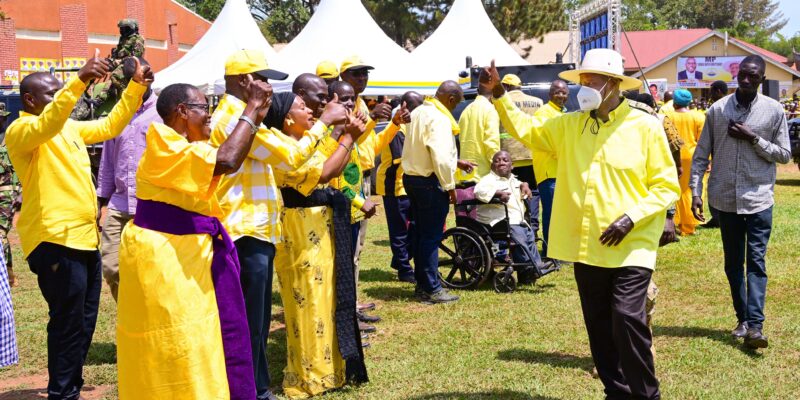
President Yoweri Kaguta Museveni on Friday 21 st November 2025,
delivered one of his most personal and historically reflective campaign
speeches as he held his second-last rally in the Busoga sub-region.
Addressing thousands of supporters who filled the Iganga District
Headquarters grounds, President Museveni intertwined wartime
memories with an extensive review of the National Resistance
Movement (NRM)’s achievements over the last four decades.
He asked Ugandans to judge the party based on what he called its
“seven pillars” of contribution to Uganda: peace, development, wealth
creation, jobs, education, infrastructure, and social services.
The NRM presidential flagbearer narrated his clandestine operations in
Iganga during the 1970s, recalling how he secretly entered the district
with 12 machine guns ferried from Tanzania and passed through Kenya
before reaching the Iganga railway station.
His recollection of hiding the
weapons in a small lodge – whose ownership he challenged locals to
research- set the pace for his campaign message.
“I thank God because many of these areas were our fighting zones,”
President Museveni said.
“In 1971 and 1972, this was a very small place. The town used to start
where the police station is, and there were only a few buildings. There
was a new lodge on the side of Busesa. I remember arriving with 12
machine guns and storing them in that small lodge while waiting for
nightfall to enter Kampala safely,” he further narrated.
The President described how he spent a full day pretending to be a
passenger at the car park, boarding a truck to Namasagali simply to
avoid arousing suspicion.
“After washing and having breakfast, I locked my room and went to the
car park. They were announcing destinations, and I listened for the
furthest—Namasagali. I traveled there just to kill time before returning
around 5 pm and then proceeding to Kampala at night with my guns,” he
recalled.
President Museveni said such memories make his presence in Busoga
deeply emotional, especially when he sees residents celebrating
peacefully—something he attributed directly to the NRM’s legacy.
“So, when I'm here during the day, enjoying with my people who are
celebrating, I thank God,” Candidate Museveni stated, reminding
supporters that Uganda’s stability was hard-won.
Gen. Museveni placed peace at the top of NRM’s contributions since
1986. He listed insurgencies such as Alice Lakwena’s Holy Spirit
Movement and others that destabilized parts of the country in the late
1980s and early 1990s.
“Even after 1986, there were still wars and instability. But now there is
total peace in Uganda. Who has brought that? It is the NRM. Nobody
else,” he explained.
He urged supporters to compare Uganda’s past turmoil with today’s
peace and security, arguing that peace is the cornerstone upon which
the rest of the country’s progress has been built.
The President said the NRM’s second major contribution has been the
building of development infrastructure—both economic and
social—which he defined in two categories: economic and social
development.
President Museveni pointed to several key roads in Busoga and Eastern
Uganda that have been constructed or rehabilitated under NRM’s tenure,
including the Kampala–Malaba Highway, which he said has been
repaired multiple times, Nakalama–Tirinyi–Pallisa–Mbale Road, a
significant commercial route, and Iganga–Kaliro Road, which serves
major agricultural zones.
He reassured residents that the long-awaited Iganga–Buloopa–Kamuli
Road is now fully funded.
“The money is there,” he declared.
On water coverage, President Museveni revealed that Iganga District’s
rural safe water coverage now stands at 77%, with 178 out of 231
villages accessing safe water. Only 22.9% of the villages remain without
reliable water sources.
The President said that when NRM assumed power, electricity barely
extended beyond Mbale.
“The plan then was to extend power to all districts, and that has been
achieved across Uganda except Buvuma,” he said.
In Iganga specifically, all 11 sub-counties have been connected to the
national grid, though he said two sub-counties still require additional
support. The next step, he added, is taking electricity to the parish and
village levels.
Regarding schools and education infrastructure, President Museveni
gave a detailed assessment of education facilities in Iganga which
includes 99 government primary schools in 42 parishes, though 11 still
have no government primary school, which he blamed on poor
distribution by district officials.
“You have more schools than parishes, yet some parishes do not have a
government primary school. Why don’t you start by ensuring each parish
gets one before adding more in already-served parishes?” he
questioned.
On secondary education, President Museveni noted that Iganga has 9
government secondary schools and more new secondary schools are
being constructed, which will leave only one sub-county in Iganga
without a government secondary school once complete.
On health infrastructure, President Museveni noted that Iganga has one
hospital, one Health Centre IV, ten Health Centre IIIs, while one sub-
county still lacks any health facility.
“We plan to upgrade Naibiri Health Centre II to a Health Centre III to
close the gap,” he said.
Wealth creation:
The President expressed concern that many Ugandans still confuse
development—such as roads, electricity, and infrastructure—with wealth,
which he said must be generated at the household level.
He used a familiar Busoga proverb – “Akange kakira akaife” to explain
his point.
“The tarmac road is ours, but wealth and poverty are yours personally,”
he told the crowd. “You may leave a rally like this one and find poverty
waiting for you at home.”
President Museveni said that this misunderstanding is the reason the
NRM, as early as the 1996 manifesto, promoted the “4-acre model,”
where small landholders allocate one acre to coffee, another to fruits, a
third to pasture for dairy, and a fourth to food crops, complemented by
backyard enterprises such as poultry, piggery, or fish farming.
He cited success stories from across Uganda to demonstrate the
effectiveness of NRM’s approach, and highlighted two model farmers:
George Matongo of Nakaseke, who built a profitable dairy enterprise
without tarmac roads or electricity, and Johnson Basangwa of Kamuli,
who earns approximately 600 million shillings per month from poultry
farming and now employs 300 workers.
“These examples show that you can become wealthy even without
tarmac or electricity,” the President said. “The medicine we told you in
1996 is correct.”
The President contrasted intensive farming with extensive farming,
which involves crops like sugarcane, maize, cotton, tobacco, or large-
scale livestock that require vast land.
“Sugarcane can earn you about 3.6 to 4 million shillings per acre per
year. But Basangwa earns 7.2 billion shillings a year from poultry on 27
acres,” he noted, underscoring the advantage of high-value, intensive
enterprises.
President Museveni defended both the Parish Development Model
(PDM) and Operation Wealth Creation (OWC). He said the real
challenge is not the programs themselves, but the decisions households
make with the money.
“You have seen people from Karamoja who rose out of poverty through
OWC. The program was across the whole country, but results depend on
what individuals choose to do with the support,” he argued.
He emphasized job creation as another major NRM achievement, citing
Sino-Mbale Industrial Park, home to 75 factories employing 12,000
people, and Namanve Industrial Park, with 273 factories employing
44,000 people.
“Altogether, the factories are employing 1.3 million Ugandans. The
government jobs are 480,000, meaning the factory jobs are three times
more than those in the government, and yet the factories are still coming
up,” President Museveni stated.
President Museveni also continued to criticize government school
administrators for illegally charging fees, arguing that such practices
undermine universal education.
“That is why I started skilling hubs,” he explained. “Children are dropping
out because of fees, yet after six months of training, they can make
shoes, furniture, liquid soap, and clothes, things we were importing.”
He praised the Presidential Skilling hub in Nakabango,Jinja, for
transforming young people’s lives. During the rally, he listened to
testimonies from youths such as Takwana Edris, who acquired
construction skills at the same center, and Sharifa Nakato, who left
school in P.6 but later trained in hairdressing and received 10 million
shillings to start her own salon. She now employs 10 people.
On the other hand, President Museveni urged NRM supporters to clearly
articulate the party’s historical and ongoing contributions when seeking
votes.
“You must be clear about these contributions – peace, development,
wealth creation, jobs, and the rest,” he said.
“People talk about many things and get disoriented. Tell them the seven
contributions. The NRM knows how to diagnose problems and find
solutions,” he added.
At the same event, NRM’s First National Vice Chairperson, Alhajji Moses
Kigongo, rallied Busoga leaders and supporters to unite behind
President Museveni.
“This is the time to ask for votes for President Museveni and all NRM
leaders. Unity and discipline will win us overwhelming support,” he said.
The NRM Vice-Chairperson for Eastern Region, Mr. Calvin Echodu
thanked President Museveni for completing the Busoga tour and
educating the public about NRM’s seven contributions.
“The people of Eastern Uganda have embraced your message,” he said.
First Deputy Prime Minister, Rt. Hon. Rebecca Kadaga welcomed
President Museveni and told him that Iganga hospital urgently needs
upgrading into a regional referral facility due to the growing population
and the hospital’s position along a major highway.
“The NRM candidate is the only one capable of delivering what Busoga
needs,” she said, urging residents to vote in big numbers.
Iganga District NRM chairperson, Mr. Walubi Abubakar thanked the
President for programs like PDM, detailing how Iganga District has
received Shs 12.956 billion, all disbursed to 12,956 households, adding
that Iganga Municipality received Shs 3.38 billion, benefiting 3,387
households. In total, 16,343 households have benefited from PDM.
He also listed other government program beneficiaries such as the 5,251
youths under the Youth Livelihood Program, the 709 women under the
Women’s Fund, and the 9,849 senior citizens under SAGE.
Mr. Walubi requested President Museveni to help them fix the non-
functional X-ray machine at Iganga Hospital and address the idle oxygen
plant, which lacks the necessary three-phase electricity. Other demands
included fast-tracking legislation to operationalize Busoga University,
and supporting the establishment of an industrial park, with potential
land available in Nakalama, Butende, and from a private landowner
named Mugoya.
The rally attracted prominent national figures, including former Vice
President Dr. Specioza Wandira Kazibwe; 3rd Deputy Prime Minister
Rukia Nakadama; Minister of General Duties in the Office of the Prime
Minister, Hon. Justine Kasule Lumumba; Minister for Presidency, Hon.
Babirye Milly Babalanda; and several MPs and NRM flagbearers from
Busoga.
What's your reaction?
You may also like
More in:National
PRESIDENT MUSEVENI URGES EUROPEAN INVESTORS TO TAP INTO UGANDA’S ECONOMIC OPPORTUNITIES
Tayebwa Issues Stern Warning to Ineffective Parliamentary Committees
Minister Babalanda Urges Ugandans in Diaspora to Invest at Home and Champion Uganda’s Global Image