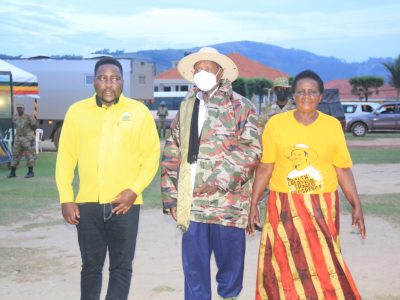
President Yoweri Kaguta Museveni has this afternoon held his final
campaign rally in the Busoga Sub-region at Kyabazinga Stadium in
Bugembe Ward, Jinja Northern Division.
The President told supporters that the 2026–2031 NRM Manifesto is
anchored on “strategic and tactical points” that emphasise the party’s
seven key contributions over the last 40 years.

“The first contribution is peace and security,” he said, recalling that
Uganda once suffered from wars and rebel groups.
“Rebel leaders like the group of Lakwena had come up to Magamaga,
but now there is peace in the whole of Uganda.”
On the second contribution— development—the President highlighted
both economic and social infrastructure. He cited roads, electricity, and
telecommunications as examples of economic infrastructure, noting that
in Jinja the government has repeatedly rehabilitated the Tororo–Jinja
and Kampala–Jinja roads.
“We are also going to do the road from Amber Court, Budondo, Kamuli
to Mbulamuti,” he added.
He said social infrastructure in Jinja City “is quite good,” with 48
government primary schools and 215 private ones, as well as 10
government secondary schools and 79 private secondary schools.

Four of the government-aided secondary schools provide both Universal
Secondary Education (USE) and Universal Post-O-Level Education and
Training (UPOLET).
However, the President cautioned that “what you should pay attention to
is the distribution of these schools”, pointing out that Jinja Rural has 59
government primary schools across 34 parishes, yet 10 parishes still
lack a single government primary school. He urged leaders to ensure
balanced distribution.
On the third NRM contribution—wealth creation—the President stressed
that it must not be confused with development such as roads.
“No one sleeps on the road,” he said. “Development is ours, but wealth
is mine and my household.”
He reiterated the need for homestead incomes and reminded the people
of Jinja of his four-acre model, which includes coffee, fruits, pasture for
dairy, food crops, and backyard enterprises like poultry, piggery for non-
Muslims, and fish farming.

President Museveni encouraged urban dwellers to utilise skilling centres
established to empower youth in trades like tailoring, welding, bakery
and other small-scale enterprises.
“Some of you in Jinja are from rural areas, but even those in the city can
do poultry farming,” he said.
On job creation—the fourth contribution—the President explained that
jobs emerge from wealth, especially through commercial agriculture and
factories.
He urged supporters to confidently defend the NRM record.
“When you go back and someone asks you why you support NRM, tell
them the seven contributions: peace, development, wealth creation, job
creation, service delivery, economic integration, and the East African
Federation.”
NRM First National Vice Chairman, Alhajji Moses Kigongo, called for
unity among party leaders, saying elections will come and go but
cohesion is vital. He urged full support for President Museveni and all
NRM flagbearers in the upcoming elections.
The First Deputy Prime Minister and Minister for East African Community
Affairs, Rt. Hon. Rebecca Kadaga requested the establishment of an
industrial park in Busoga, saying land is already available in Budondo.
She also appealed for faster commencement of the Jinja Expressway,
arguing that traffic on the current Jinja Road “slows down business
because of the many cars it takes.”
Former Vice President, Dr. Specioza Wandira Kazibwe called for
common user facilities to support youth engaged in innovation and
requested additional skilling centres to curb high illiteracy levels in the
region.
The NRM Chairperson for Jinja City, Mr. Edwin Lufafa, thanked the
President for the enormous development in Jinja City but noted
challenges such as the lack of markets—citing Bugembe Ward, which
has none—and the absence of a general hospital, pointing out that Jinja
City relies solely on the regional referral hospital.
Jinja District NRM Chairperson Mr. Moses Batwala also thanked the
President for ongoing government programmes such as the Parish
Development Model and Emyooga, which he said have supported
livelihoods across the district.
Before the rally, President Museveni officiated at the groundbreaking
ceremony for the construction of the Busoga Kingdom Headquarters,
marking a major milestone in the cultural and administrative
strengthening of Obwa Kyabazinga Bwa Busoga.
The ceremony took place in Bugembe, Jinja City.
The preliminary cost estimate for the construction of the complex is
approximately Shs 80 billion.
This includes the administration block,
commercial blocks, and all external works, complete with installations,
fittings and furniture.
Additional Shs 50 billion is estimated for the Cultural Village, Museum,
TV and
Radios Stations, Shopping Center, Recreational Facilities and
Infrastructure services including Solid Waste and Sewer Systems, High
Voltage Power supply, Water, Internet and ICT Installations.
What's your reaction?
You may also like
More in:National
Take Parliament to the People, Tayebwa Advise MPs
Minister Babalanda Warns Basoga Against Land Fragmentation, Urges Families to Embrace Wealth-Creation
PRESIDENT MUSEVENI URGES EUROPEAN INVESTORS TO TAP INTO UGANDA’S ECONOMIC OPPORTUNITIES