The App That’s Quietly Rewriting the Rules of Renting
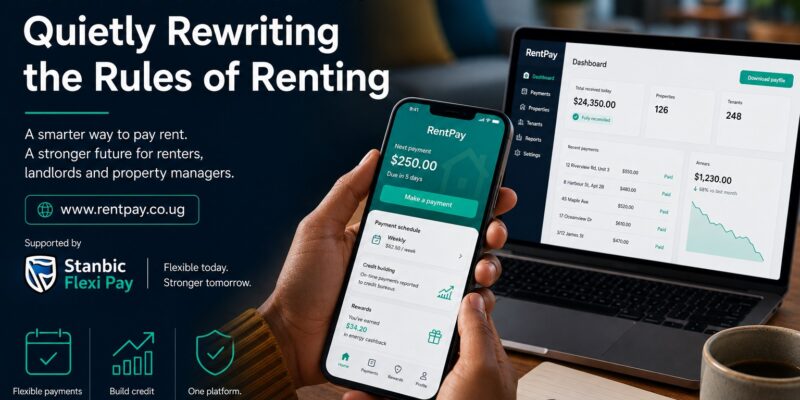
Rent day used to mean dread. A platform called RentPay is working to change that, for tenants, landlords and property managers at once. And it might just be the most underrated technology story of the decade.
By Judith Nansumba · Guest Contributor
There is a certain ritual to the first of the month. For millions of renters, it arrives with a tightness in the chest, the scramble to check bank balances, to remember which account linked to which landlord, to pray the transfer clears before someone starts chasing you.
For property managers, the same date means a different kind of storm: a blizzard of incoming payments, mismatched references, partial deposits, and the soul-crushing labour of reconciling it all in a spreadsheet and notebook. Rent, for most of human history, has simply been a pain.
But quietly, methodically, and without the fanfare usually reserved for Silicon Valley unicorns, a platform called RentPay has been dismantling that ritual and replacing it with something far more civilised.
I have spent several weeks digging into how it works, who it serves, and what it signals about the future of the rental economy and I believe this is a story the technology press has underestimated.
“Rent is not just a transaction. It is the financial heartbeat of someones home.
Getting it wrong, even once, has consequences that ripple through peoples lives.”
— Mustapha, RentPay Head of Partnerships
What RentPay Actually Does
At its simplest, RentPay is a rent payment platform. Tenants use it to pay their rent; landlords and property managers use it to collect it. But that single sentence dramatically undersells what is happening under the hood.
The platform gives tenants genuine flexibility, they can choose how and when to pay, splitting a monthly obligation into weekly or fortnightly cadences that align with how most people actually get paid.
Automated SMS and push reminders mean that a forgotten due date becomes a near-impossibility.
And for the growing cohort of renters with irregular income freelancers, gig workers, casual employees, RentPay offers a payment buffer to smooth out the lumps of an unpredictable income cycle.
Flexible Scheduling
Tenants choose weekly, fortnightly, or
monthly synced to their paycheck, not
the landlord's calendar.
Credit Score Building
On-time rent payments are reported,
turning a lifelong obligation into a
ladder toward financial credibility.
One Daily Deposit
Property managers receive a single,
fully reconciled daily transfer. Hours
of admin collapse into minutes.
The Problem Nobody Was Solving
What makes RentPay remarkable isnt any single feature, its the recognition that everyone in the rental ecosystem was losing, just in different ways. Tenants were losing time, money, and stress.
Landlords were losing sleep over arrears. Property managers were losing entire days to the administrative fog of rent collection.
The industry had digitalised its listings, virtualised its inspections and automated its marketing, but left the core transaction stubbornly analogue.
Consider the reality. A property manager handling a rent roll of even fifty properties is coordinating fifty separate payment relationships, each with its own bank account, reference number, timing preference, and
failure mode. Chase-up calls, reconciliation errors, receipts generated by hand, these tasks dont just drain productivity.
They create gaps where arrears quietly accumulate, disputes emerge, and tenancies break down.
RentPay recognised this friction and built a product around removing it entirely.
Rent as a Financial Tool, Not Just a Cost
Here is where the story takes a turn that I find genuinely inspiring.
RentPay didnt stop at making payments easier. They asked a more subversive question: what if rent, that monthly haemorrhage of cash, could actually help renters get ahead?
The answer came in two forms. First, a credit-building feature that reports on-time rent payments to credit agencies. This is transformative in a way thats easy to understate.
For most renters, particularly younger people or recent immigrants, rent is their single largest recurring financial commitment and yet it has historically contributed nothing to their credit profile. A mortgage payer builds credit with every payment.
A renter, paying on time for years, gets nothing. RentPay is fixing that asymmetry.
Second, a cashback rewards programme that lets renters earn back a percentage on their energy bills simply by using the platform. Its a small thing, individually.
In aggregate, it signals something profound:
the belief that renters deserve to be rewarded for financial responsibility, not merely penalised for lapses
in it.
“Renters represent nearly a third of households in many markets. A technology that turns their largest monthly payment into a credit-building, reward-earning asset isnt a feature. Its a reclassification of what it means to rent.”
The Property Managers Quiet Revolution
For property managers, the headline improvement is time. What once consumed an afternoon, cross-referencing incoming payments, generating receipts, identifying shortfalls, sending reminders, now happens automatically.
Payments are batched into one clean daily transfer, fully reconciled, with linked payfiles delivered directly to inboxes or downloadable from the portal.
The platform is free for agents, with no lock-in contract. The result is a measurable drop in arrears and a significant reduction in
administrative overhead.
EDITORS NOTE — WHY THIS MATTERS
The property management industry has long been a late adopter of technology, partly because its margins are hin, partly because its processes are deeply habitual.
A platform that doesnt ask agents to change their software stack, just integrates into it, is a much easier sell than a wholesale replacement. RentPays integration-first approach is not a compromise. Its a strategy.
A Blueprint for Thoughtful PropTech
I have written about enough technology companies to recognise the difference between a product built to extract value from a market and a product built to create it.
RentPay sits firmly in the latter category. It wasnt conceived in a boardroom far removed from the people it serves.
It emerged from conversations with casual workers who missed payments not out of irresponsibility but out of timing mismatches, with property managers buried in reconciliation, with renters who simply wanted less stress.
The best technology doesnt impose a new behaviour on users; it recognises the behaviour they are already trying to have, and makes it frictionless. RentPay didnt invent the desire to pay rent reliably and receive it
cleanly.
It simply removed every obstacle in between.
The Larger Picture
We are living through a remarkable period in which the physical world, housing, transport, food, health is being rewired by digital infrastructure. Most of the attention goes to the glamorous end: smart buildings,
AI-generated floor plans, virtual reality property tours.
But the infrastructure that actually enables people to remain housed, the payment rail, the reconciliation system, the reminder that arrives at exactly the right moment is less photogenic and equally vital.
RentPay is infrastructure. It is the kind of technology that, once embedded, becomes invisible, not because it has failed, but because it has succeeded so thoroughly that the problem it solves is forgotten.
Rent day, for its users, no longer means dread. It means a notification, a cleared payment, a credit point quietly logged, and perhaps a small cashback on a utility bill. The revolution, if youpermit me the word, is extraordinarily quiet.
That, I would argue, is exactly how the best technology revolutions go.
What's your reaction?
You may also like



More in:Opinion

MBAGADHI FREDERICK NKAYI: UGANDA’S LAND PARADOX, LAWLESSNESS AMIDST RICH LAWS

HON. DR. ABBAS AGABA: Uganda’s Independence and the Unfinished Business of African Unity

FATUMAH HUSSEIN: The Future of Work in Africa: Can AI Turn Youth Employment into Economic Opportunity

KAGENYI LUKKA: Hon. Babalanda’s First 100 Days as Budiope West MP Depict Her as a Transformational Leader