President Yoweri Kaguta Museveni has called on Italian investors to
partner with Uganda in agriculture, mineral processing, coffee production,
electric vehicle manufacturing and technology transfer, emphasising the
need for investments that promote local production, create jobs and
accelerate industrialisation.
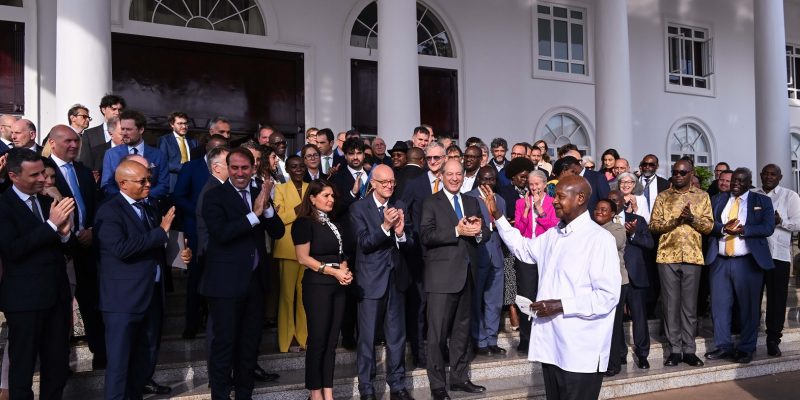
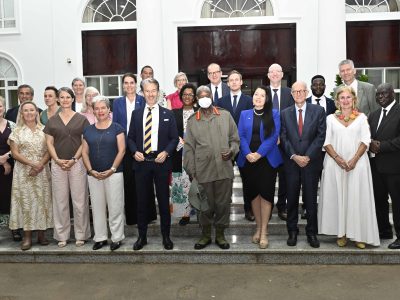
The President made the call while meeting a delegation of more than 80
Italian government officials, investors, business representatives and
development partners at State House, Entebbe, on Saturday 7 th November,
2026.
President Museveni said Uganda and Italy had enormous potential to
deepen their economic and diplomatic relations, urging European countries
to support Africa’s industrialisation by investing in production and
processing rather than relying on the export of raw materials.
“Why would you want to do business with a poor man if you really
understand that prosperity comes from business, from trade? Why do you
want to trade with a poor man? I want my trading partner to be rich,” he
said.
He explained that prosperity was driven by the production and exchange of
goods and services with economic value.
“Prosperity comes from business. If you want prosperity, you must do
business. Business means producing a good or a service of economic
value and selling it. The more you sell, the more prosperous you become,”
he said.
The President noted that Africa’s continued dependence on exporting raw and semi-processed materials was denying the continent significant
earnings, particularly in the agricultural and mineral sectors.
Using coffee as an example, President Museveni said Uganda earns
slightly more than $2 per kilogramme of exported coffee, while fully
processed coffee products fetch considerably higher prices in European
markets.
“This kilo in Europe is like $40 or more,” he said, arguing that establishing
processing facilities in Uganda would enable the country to retain more
value from its agricultural products.
“I am sure if we add value here, we will get more from a kilo than $2, and
that will give us more money and jobs,” he added.
President Museveni welcomed Italian investors interested in establishing
coffee processing factories in Uganda, saying the Government was ready
to facilitate partnerships in the sector.
“For coffee, we are going to build factories here. I welcome you,” he said.
He further emphasised that Africa and Europe had a natural opportunity to
prosper together, citing Africa’s geographical proximity to Europe, abundant
natural resources and rapidly expanding population.
“In the next 30 years, Africans will account for 25 per cent of the world's
population. This represents a huge market that European leaders and
investors should not ignore,” President Museveni noted.
On mineral resources, the President called for increased local processing,
noting that Africa continued to lose significant economic opportunities by
exporting minerals without sufficiently adding value.
He said the continent needed investments capable of transforming its
natural resources into finished products, expanding industrial capacity and
creating employment.
“Africa has abundant minerals, agricultural resources and a growing pool of
human skills and talents needed for industrialisation. What we need are
investments that transform these resources into finished products, create
jobs and expand trade,” he said.
The President also invited Italian companies to partner with Uganda in
manufacturing lithium batteries for electric vehicles, noting that the country
had lithium deposits and was already pursuing electric vehicle
manufacturing.
President Museveni said battery production presented an important
opportunity for technology transfer and industrial collaboration, given the
significant role batteries play in electric vehicle manufacturing.
“I am making my electric vehicles now, but I want a partnership in making
batteries. We have lithium here, but I want a partnership. If you could get
me people to share with me, because an electric battery is a bigger part of
the electric car,” he said.
He urged the Italian business community to embrace mutually beneficial
partnerships, pointing to the success of Chinese and Indian-owned
factories operating in Uganda.
“I am very happy to talk to you, but we need a partnership of win-win. I can
assure you these factories of the Chinese and of my Indian tribe here are
very active. It is being short-sighted to have a win-lose strategy; a win-win
is better,” he said.
President Museveni also highlighted the importance of expanding global
prosperity, recalling how China’s industrialisation and economic growth had increased demand for steel, creating opportunities for producers in other
parts of the world.
He said Uganda would similarly benefit from expanded international trade
and investment, particularly through the utilisation of its mineral resources,
agricultural potential, freshwater resources and skilled human capital.
“The opportunities are very clear: investments using abundant raw
materials; raw materials from minerals, agriculture, fresh water and human
skills,” he said.
The President also welcomed Italy's growing interest in Uganda and
expressed appreciation to the delegation for visiting the country to explore
areas of cooperation.
Prime Minister, Rt. Hon. Robinah Nabbanja said Uganda and Italy had
continued to strengthen their cooperation following her visit to Rimini, Italy,
in 2024, where she held discussions with Italian Deputy Prime Minister
Antonio Tajani on Uganda’s development priorities.
Rt. Hon. Nabbanja said the engagements focused on several areas,
including coffee development, waste management, healthcare and
agricultural mechanisation.
She noted that Italy had since reopened its development cooperation office
in Uganda, which also serves Rwanda and Burundi, strengthening the
framework for implementing development programmes and providing
grants, particularly in the health sector.
The Prime Minister said the two governments, working through Uganda’s
Ministry of Finance, Planning and Economic Development and the Solicitor
General, had prepared a framework agreement on development
cooperation that was scheduled for signing.
She also acknowledged Italy’s support towards Uganda's coffee sector,
revealing that the country had mobilised €120 million, with €60 million
expected as the first instalment.
The European Union had separately pledged €44 million towards the same
initiative.
Rt. Hon. Nabbanja said the funding would support efforts to improve coffee
production, processing and quality, with the United Nations Industrial
Development Organization (UNIDO) also supporting Uganda’s
interventions in the sector.
She further revealed that construction of the Uganda-Italy Coffee Training
Centre at Kyambogo University had been commissioned, describing the
project as an important milestone in building local expertise.
The centre is expected to equip Ugandans with skills in coffee processing,
roasting and quality improvement.
“Yesterday, I commissioned the commencement of construction of the
factory at Kyambogo University, and this was a big milestone.
The centre is going to help us in training our people. It is a grant from Italy which is going to train Ugandans in coffee processing, roasting and quality improvement.
I want to thank the Government of Italy for this,” Rt. Hon. Nabbanja said.
On urban development, the Prime Minister highlighted a €70 million Green
Cities initiative being implemented in partnership with the Food and
Agriculture Organization (FAO).
She said the programme would support the development of cleaner and
more resilient urban centres while improving food safety, market conditions
and environmental sustainability and creating economic opportunities for
communities in Kampala and Hoima.
“Your Excellency, this is a grant also provided to you by the Government of
Italy,” she said.
Rt. Hon. Nabbanja also announced a €12.75 million grant from Italy
towards the Prevention, Research and Integrated Services for Maternal,
Child and Cancer Health Care project, known as PRISMA.
She said the Italian organisation AVSI would implement the project in
collaboration with Uganda’s Ministry of Health.
The Prime Minister further highlighted cooperation between Ugandan local
governments and Italy’s Basilicata region, revealing that Greater Hoima,
Greater Masaka and Mubende had jointly designed a €7 million pilot
training programme focusing on food security and agricultural
mechanisation.
She said the programme could help attract private investment and support
the implementation of Uganda's Tenfold Growth Strategy.
Rt. Hon. Nabbanja added that the cooperation would create opportunities
for Uganda’s business community to access concessional financing and
grants to support value addition in agricultural and mineral products.
She expressed gratitude to the Italian Government for its continued interest
in Uganda and the growing number of Italian investors exploring
opportunities in the country.
“We have signed an agreement, and we are going to make sure that the
two sister countries get areas of development in the business community.
We have also got grants to add value to our products, minerals, agricultural
products and many others.
So we are very grateful that at least we are attracting investors from Italy,” she said.
The Italian delegation reaffirmed its country's commitment to strengthening relations with Uganda, describing the country as a priority partner and expressing interest in expanding cooperation across several sectors.
Speaking on behalf of the delegation, Riccardo Guariglia, Secretary-
General of Italy’s Ministry of Foreign Affairs, said the delegation comprised
more than 80 representatives drawn from development cooperation
agencies, civil society, universities, local authorities, the financial sector,
healthcare, business and the defence industry.
He thanked President Museveni for receiving the delegation at State
House, saying the visitors felt welcome in Uganda.
“Uganda is a priority country for us. The composition of this big delegation
shows the interest,” Mr. Guariglia said.
He explained that Italy's approach to development cooperation was based on equal partnerships, technology transfer and sharing expertise rather
than charity or imposing solutions on partner countries.
“Our philosophy of cooperation towards Uganda is very easy. We want to
work among peers. We don’t want to impose anything. We don’t want to
make any charity. We want to transfer technology and know-how, and we
all support this approach,” he said.
Mr. Guariglia identified healthcare, agriculture, coffee development and
environmental sustainability as some of the key areas in which the two
countries could deepen cooperation.
He also announced that the visit would include the signing of an important
agreement to provide a legal framework for bilateral development
cooperation activities, particularly those undertaken through Italy’s
cooperation office in Uganda.
The Italian representative commended Uganda’s contribution to regional stability and its role in hosting and protecting refugees.
“We look to Uganda with great respect and cooperation because, under
your leadership, Mr. President, your country is fostering stability in the
region. We appreciate this role and think that you play a role with
remarkable visibility in providing protection to refugees, and this is also
something which is very important,” he said.
He said Italy valued Uganda’s contribution to regional peace and stability
despite the geographical distance between the two countries.
The delegation expressed optimism that the engagements would open new
opportunities for investment, trade and stronger institutional cooperation.
The meeting culminated in the signing of a bilateral Development
Cooperation Agreement between Uganda and Italy, witnessed by President
Museveni. The agreement provides a framework for strengthening the
partnership and advancing mutually beneficial cooperation between the two
countries.
What's your reaction?
You may also like
More in:Business

Personal care is not a gender issue. It is a matter of health, hygiene and self-confidence
AAYC, NIMD Explore Strategic Partnership to Advance Youth Leadership, Democracy and Peacebuilding
PRESIDENT MUSEVENI URGES SHEEMA FARMERS TO EMBRACE IRRIGATION, COMMERCIAL AGRICULTURE TO FIGHT POVERTY
PRESIDENT MUSEVENI URGES EUROPEAN INVESTORS TO TAP INTO UGANDA’S ECONOMIC OPPORTUNITIES