Deputy speaker hails National Water on Shs 1.2 trillion massive Katosi water facility

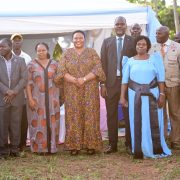
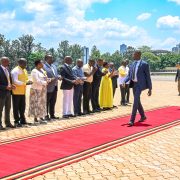
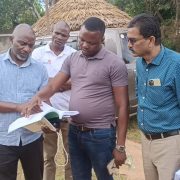
MUKONO — The Deputy Speaker of Parliament, Thomas Tayebwa yesterday inspected a Shs1.2 trillion water project and hailed the National Water and Sewerage Corporation (NWSC) as a model in improved service delivery to Ugandans.
Mr. Tayebwa who was inspecting the new Katosi water plant in Mukono District, applauded NWSC management for proper use of the Euro 300m loan which was approved by Parliament.
The new facility at Katosi is a pumping station, treatment plant and the reservoir installed by NWSC and the Ministry of Water and Environment (MWE)
“I want to congratulate the NWSC, the Ministry of Water and Environment, and the Government at large for the absorption of this loan. I am really glad the project has been completed. We have loans of 2011 and have gone just 10 percent of work completed,” said Tayebwa.
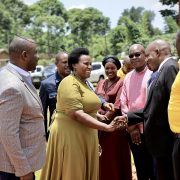
The Deputy Speaker was received by the NWSC officials led by Eng. Dr. Silver Mugisha, the utility Managing Director.
Mr Tayebwa revealed that he was happy that the modern water treatment plant at Katosi has an installed capacity of treating 160m litres of water pumped from Lake Victoria. He was however, concerned with the underutilization of this water with only 52 percent of treated water being released to the community in the Kampala metropolitan areas as there is still some work to complete.
“We have been told that 48 percent of the total capacity is still underutilized and we have money lying idle. It is of concern to find that water can be pumped, is available and you find people have no water.”
He added: “We want to utilize up to the current recommended capacity so that the unexplained cutoff of water in Kampala is done with.”
This was after NWSC boss Eng. Mugisha informed the Deputy Speaker that Euro 60m (about Shs241.2b) remains on the account because there is need of Shs181b top up to be able to complete the installation of a 15m litres water reservoir at Matugga with hope to cover most parts of Wakiso District.
Impressed with the utilization of the loan which himself as a former member of the Committee on the National Economy in the 10th Parliament supported, the Deputy Speaker promised to guide the legislators when the request for additional funding to NWSC comes in the next budget cycle.
“What we find on the ground determines where we put more money for service delivery. Out of the budget (FY2023/24) of Shs51trillion, we have unfunded priorities of over Shs200 trillion. I don’t see a reason for cutting the budget of NWSC and we are going to engage the Ministry of Water, the Ministry of Finance and the Prime Minister to ensure they expedite the proposals for top up funding.
In 2011, Parliament approved two loans worth Euro 75m (about Shs301.6b) each while the 10th Parliament in 2018 approved another loan of Euro 150m (about Shs603.1b) with the purpose of transforming the water sector in the Kampala metropolitan area.
Currently, the Deputy Speaker is inspecting projects implanted by MDAs taking the largest amount of money on the budget sourced from external financing.
On Tuesday, while touring the construction site of the Busega-Mpigi Expressway, the deputy speaker expressed dissatisfaction with the delays in the implementation of the project.
The 35.41km, four-lane dual carriage highway project is being constructed by a consortium of Chinese companies, that includes China Civil Engineering Construction Corporation (CCECC) and China Railway 19th Bureau Group Company Limited at a cost of Shs497.2b which is a loan from the African Development Bank.
Mr Mugisha reported to the deputy Speaker that the corporation is spending at least Shs800b a year on electricity supply to run the Katosi plant, something that makes it expensive for them.
“We are spending too much money on power. Our line of power has to be dedicated. As we use a commercial tariff (plan), we want to request the Ministry of Energy to put us on the domestic tariff,” said Mugisha.
He also revealed that NWSC is more concerned about extending safe drinking water to more Ugandans who have not yet gained access to clean water and it will remain a difficult target to achieve with high power tariffs to run the pumping and treatment plants.

Speaking about the Katosi project, Mr Mugisha told journalists that the request for the Euro 45m (about Shs181b) top-up funding to the unutilized Shs241.2b meant for the construction of another reservoir has already been approved by President Yoweri Museveni.
Meanwhile, the Deputy Speaker advised the NWSC to explore means of finding partners to install a standby solar energy plant as a way of cutting the high costs of hydro electricity power needed to run the plant and conserving environment through renewable energy development initiatives.
Mukono District Woman Member of Parliament, Hanifa Nabukeera commended the deputy speaker for sparing time to inspect service delivery projects across the country and thanked the central government for finding funds for the water project. She explained that the water plant would help her constituents get access to clean water for drinking and domestic use.
“The people of Mukono and the neighbouring areas will get water.
Fred Kayondo, the Mukono South MP, whose constituency hosts the NWSC water treatment plant said: “Now that the supply lines for connecting the surrounding communities to water are in place, the government needs to work on the rural electrification in the area.
What's your reaction?
You may also like
More in:Uganda
Focus on Climate Action, Tayebwa Tells MPs
64th Independence Day to Be Celebrated at State House – Minister Babalanda
President Museveni Fulfils UGX 50 Million Pledge for Fr. Bagumisiriza’s Marriage Book.
ALL SENIOR SIX VACISTS TO UNDERGO PATRIOTISM TRAINING AT NALI