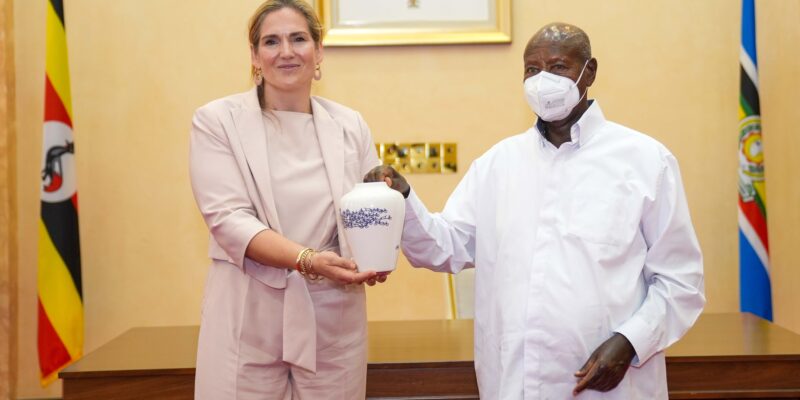
President Yoweri Kaguta Museveni today met and held talks with the
Ambassador of the Netherlands to Uganda, H.E. Frederieke Quispel at
State House, Entebbe.
The discussions mainly focused on agriculture; animal feeds, fish
farming and economic cooperation between Uganda and the
Netherlands.
A key area of discussion was the growing demand for raw materials to
support Dutch investments in Uganda’s animal feed industry, including
the De Heus Fish Feed Factory in Jinja.
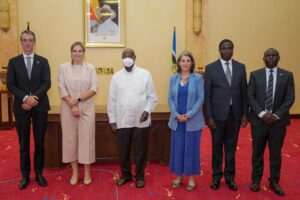
During the meeting, President Museveni emphasized the need to
increase production of key agricultural raw materials such as maize,
cassava and soya to support the expanding animal feeds sector.
“We shall now produce more maize and cassava,” President Museveni
said.
The President revealed that he intends to convene a conference of
maize growers to discuss ways of boosting production to meet the
increasing demand from factories producing animal feeds.
“I am going to convene a conference of maize growers,” he noted.
President Museveni also observed that tax duty on animal feeds
produced within Uganda should be removed in order to support local
production and attract more investment into the sector.
On environmental conservation, the President said the government is
promoting fish farming as an alternative source of livelihood aimed at
reducing encroachment on wetlands.
“I want you to do fish farming as a strategy to get the locals out of the
wetlands. I want to get those rice growers out of the wetlands,” he said.
In her remarks, H.E. Quispel described her posting in Uganda as the
best assignment in her diplomatic career.
“This is the best job I have had in my entire career,” she said.
The Ambassador also conveyed congratulatory messages and best
wishes from the King of the Netherlands to President Museveni, noting
that the Netherlands looks forward to strengthening economic
collaboration with Uganda.
She disclosed that about 60 Dutch businesses are currently operating in
Uganda, making the Netherlands one of Uganda’s largest foreign
investors.
“We are your largest foreign investor and we are honored with you
opening up those factories in animal feeds,” she said.
H.E. Quispel, however, noted that factories involved in animal feed
production are facing challenges in accessing enough raw materials
locally and are forced to import some products, including Soya from
Zambia.
“Those factories have difficulty in finding the raw materials and are
forced to import some soya from Zambia, as well as maize and cassava.
We work with smallholder farmers but the supply is still not enough,” she
explained.
She added that Dutch investors are willing to invest in cooperatives to
help increase production, noting that there is growing demand for raw
materials used in animal feeds manufacturing.
“Our people are willing to invest in these cooperatives. There is a lot of
demand for these raw materials for feed,” she said.
The Ambassador further noted that the Netherlands has drawn
inspiration from Uganda’s agricultural sector and expressed optimism
about continued cooperation between the two countries.
What's your reaction?
You may also like
More in:National
Tayebwa Issues Stern Warning to Ineffective Parliamentary Committees
Minister Babalanda Urges Ugandans in Diaspora to Invest at Home and Champion Uganda’s Global Image
Minister Babalanda Roots for Coordination, Accountability to Drive Wealth-Creation

We Must Honor the Builders of PLU in Western Uganda