President Museveni meets Standard Chartered Bank top officials, discuss project financing in Uganda

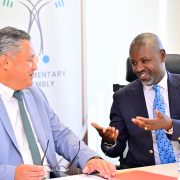
President Yoweri Kaguta Museveni has today met and held discussions with a team from Standard Chartered Bank Uganda and UK at State House, Entebbe.
During the meeting, President Museveni and the delegation members discussed how well projects can be financed in Uganda.
The President thanked the bank for supporting the infrastructure in the country but requested them to also put emphasis on the issue of wealth creation because it will expand production.
“If you make a road or Standard Gauge Railway but do not have enough to transport, then you will still have problems and you can even be overtaken by social issues like unemployment. So there should be a step on the infrastructure side but also a step on the wealth creation side,” he said.
“On the wealth creation side, there are the four sectors which include commercial agriculture which we are handling ourselves, but there’s manufacturing now where we have a lot of raw materials, but they are not transformed into finished products. We need more in that area so that when there’s infrastructure, there are ready goods to move along on it. So, if you do the infrastructure and also do some manufacturing using our raw materials, that will quickly expand the economy.”
President Museveni also informed the delegation that Uganda is now targeting an economy of USD 500 billion in the near future.
“The raw materials, the energy as well as some of the infrastructures are already there but what is not there adequately is the manufacturing and the dedicated Ugandans are there but they don’t have capital,” he said.
“In the projects you are talking about, I think the immediate ones should be the Umeme buy-out, SGR and irrigation because we want to stabilize agriculture and Industries.”
On the other hand, President Museveni told his guests that Uganda’s economy performs well because the National Resistance Movement government managed to study and deal with the problems caused by philosophical, ideological and strategic mistakes.
“There’s no chance that we have ever made any of those mistakes; we are very sure of what we are doing, and we are lucky that we are part of this very powerful part of the world; Africa where the problem has only been leadership both in the past with our kings, during colonialism and post-independence,” he stressed.
“Our economy cannot do badly because we have got a lot of natural resources. We philosophically resolved the issue of understanding the role of the private sector because part of the problem in Africa is that they don’t understand the role of the private sector. This is a philosophical mistake.”
Furthermore, President Museveni requested the delegation to bring in more foreign investors to Uganda to invest in the various sectors of the economy.
Mr. Faruq Muhammad, the Managing Director and Global Head of Structured Export Finance at Standard Chartered Bank thanked the President for creating an enabling environment that has allowed them to finance various projects in the country.
“Uganda is a very good market for us. My first visit to Uganda was when we were financing Warid Telecom (now Airtel) which had just received an operational licence. As an international institution, we have a lot of tools and products and we appreciate the opportunity to use them as a joint benefit for the government and us partners,” Mr. Muhammad said.
“Now we are looking at some key projects like the transmission lines, Kidepo Road Projects and some of the oil roads.”
The Board Chairperson of Standard Chartered Bank Uganda, Ms. Maria Kiwanuka said the bank has been a good cadre of economic development in the country.
“There are quite a number of projects that we have executed here in collaboration with the Ministry of Finance, Planning and Economic Development. We have worked very well with the government of Uganda in several areas especially the infrastructure development,” she said.
The Managing Director/CEO of Standard Chartered Bank Uganda, Mr. Sanjay Rughani informed President Museveni that the bank is the oldest financial institution in Uganda, having existed for 112 years.
“For all these years, we have always wished good for Uganda and we have always supported the nation’s development agenda,” he said.
Mr. Sanjay also noted that Standard Chartered Bank has contributed to 3 percent of the country’s GDP through lending, value addition and supporting projects.
“We are currently working on projects worth USD 1.3 billion. In recent times, we have submitted our interest to finance many other projects such as SGR, Umeme buyout, among others, all worth USD4 billion of investment,” he said.
“We not only do project financing here, but we also engage in international partnerships that are very crucial for Uganda. This can only happen when we have an enabling environment which has been achieved under your leadership. Manufacturing is also very key, that is why we have lent Shs400bn to manufacturers.”
Mr. Sanjay also congratulated the President for his visionary leadership that has enabled Uganda to be strong and resilient amid the current challenging global economic times.
What's your reaction?
You may also like
More in:Business

Personal care is not a gender issue. It is a matter of health, hygiene and self-confidence
AAYC, NIMD Explore Strategic Partnership to Advance Youth Leadership, Democracy and Peacebuilding
PRESIDENT MUSEVENI URGES SHEEMA FARMERS TO EMBRACE IRRIGATION, COMMERCIAL AGRICULTURE TO FIGHT POVERTY
PRESIDENT MUSEVENI URGES EUROPEAN INVESTORS TO TAP INTO UGANDA’S ECONOMIC OPPORTUNITIES