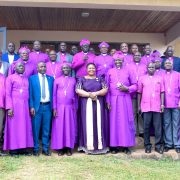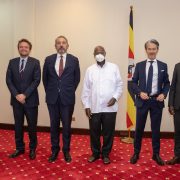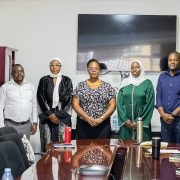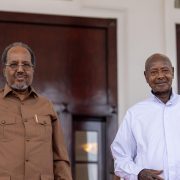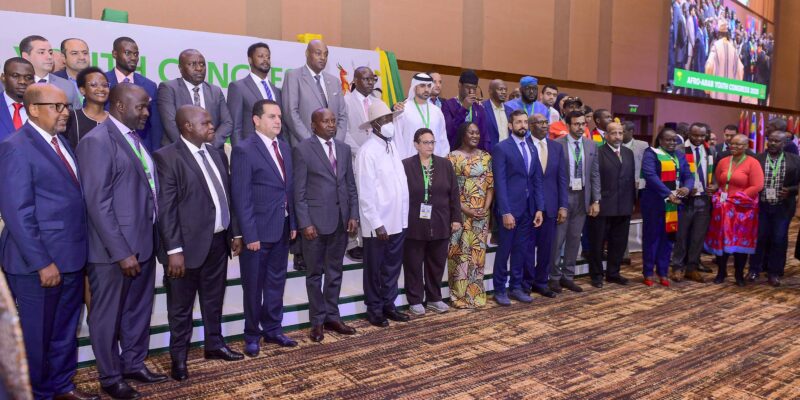
President Yoweri Kaguta Museveni has officiated at the closure of the Afro-Arab Youth Congress 2025 at Speke Resort Munyonyo, urging young people across Africa and the Arab world to embrace ideology, unity, and innovation as tools for peace and prosperity.
The five-day congress, held under the theme: “Amplifying Youth Voices for Peace, Unity and Prosperity,” ran from October 6 to 10, 2025, bringing together youth leaders, government officials, diplomats, and representatives from across Africa and the Arab world to chart a new course for collaboration and progress.

The President noted that Africa’s population currently stands at 1.5 billion people and is projected to reach 2.5 billion in the next 30 years, saying this demographic shift positions the continent as the future of global growth.
“You young people need to know that you belong to the future of the world. The future belongs here in the Afro-Arab world,” he said.
He observed that while Africa is blessed with favorable weather and abundant natural resources, the same environment also supports challenges such as tsetse flies and malaria.
“Africa has a good climate, but that climate is also good for Africa’s enemies like tsetse flies, malaria, and other diseases,” the President remarked, stressing the need for young innovators to find homegrown solutions to such problems.
President Museveni identified ten strategic bottlenecks that continue to hold Africa back, emphasizing that ideological disorientation remains one of the most dangerous. He explained that Africa’s political weakness has often stemmed from focusing on identity rather than shared interests.
“The most important question in politics is: is it about identity or about interests?” he said. “In the case of Sudan, some people destroyed their country by introducing politics of identity — of tribe and religion. Even here in Uganda, some tried to bring it, but we rejected it. We said what we need is politics of interest, because prosperity comes from selling a good or a service, not from tribalism.”
He added that political parties that dwell on tribal or sectarian lines cannot build strong national movements.
“How can you have a political party that can win elections if you are emphasizing tribes?” he asked, warning that such divisions destroy nations rather than building them.
The President also cited a fragmented market as another obstacle to Africa’s progress, noting that meaningful development requires production supported by consumers with purchasing power.
“Development comes when you produce a good or service. You must have a society of wealth creators. But Africa is divided into 55 small markets — who will buy what you produce?” he asked.
He pointed out that while regional blocs such as the East African Community (EAC) and ECOWAS exist, they are not yet fully functional, while the Maghreb Union could not take off because of internal challenges. He therefore challenged the youth to embrace ideology-driven leadership.
“What is your ideology?” he asked. “I recommend to you the ideology of patriotism — love your country, whichever it is — but also be young Pan-Africanists because Uganda cannot thrive without Africa.”
President Museveni said Ugandans have learned that their internal market alone cannot sustain production, as the country now produces surpluses of nearly everything.
“Ugandans used to be sectarian, but after waking up they realized that the internal market is not enough for their goods,” he explained.
“Ideology is like a medical prescription — if it is wrong, the patient will die.”
President Museveni also launched a fundraising drive for the Afro-Arab Youth Congress, aimed at strengthening youth empowerment programs across Africa and the Arab world.
Ms. Chido Cleopatra Mpemba, the Special Envoy to the African Union Chairperson on Youth and Gender Issues, applauded President Museveni for giving women and young people a strong voice in leadership.
“We thank President Museveni for giving a platform to women. Uganda is an example to the continent because its Cabinet includes women at the highest levels — the Vice President, the Prime Minister, and several other key ministers.”
The Deputy President of the Republic of Kenya Kithure Kindiki praised the Afro-Arab Youth Congress as a bridge between the two regions, saying it provides “a vital forum for building understanding and cooperation between Africa and the Arab world.”
He emphasized that youth are at the center of enterprise and innovation.
“Young people today are creating enterprises that offer new solutions.
They are not just leaders of tomorrow — they are leaders of today.”
Reaffirming Kenya’s commitment to regional cooperation, he added, “To the youth, this is your time to stand. The future is not promised — it is created.”
Representing His Highness Sheikh Mohamed bin Zayed Al Nahyan, President of the United Arab Emirates, the UAE delegation reaffirmed the Emirates’ belief in youth as drivers of transformation.
“We firmly believe in the youth as changemakers,” he said. “In the UAE, we launched a national youth agenda to empower young people to shape the future. My dear youth, we believe in you — you have the passion and energy to transform our world.”
The President of the Afro-Arab Youth Congress, H.E Abdul Haddi Lahweej underscored the shared destiny between Africa and the Arab world, saying, “Arab and African nations live side by side and face similar challenges.”
He revealed that Libya is “providing thousands of jobs to support youth and help rebuild our nation,” and questioned why Africa, with its abundant resources, remains poor.
“How can Africa, with all its wealth, still be poor?” he asked. Africa needs to push its pace and change how it does business if we are to catch up with the rest of the world.”
He also called for peace and a united stand against oppression, especially in Palestine.
“Africa must push for peace and stop wars. We must also strongly condemn oppression against Palestinians because peace is not an option — it is a necessity.”
What's your reaction?
You may also like
More in:Business

Personal care is not a gender issue. It is a matter of health, hygiene and self-confidence
AAYC, NIMD Explore Strategic Partnership to Advance Youth Leadership, Democracy and Peacebuilding
PRESIDENT MUSEVENI URGES SHEEMA FARMERS TO EMBRACE IRRIGATION, COMMERCIAL AGRICULTURE TO FIGHT POVERTY
PRESIDENT MUSEVENI URGES EUROPEAN INVESTORS TO TAP INTO UGANDA’S ECONOMIC OPPORTUNITIES