By Wilfred Arinda Nshekantebirwe
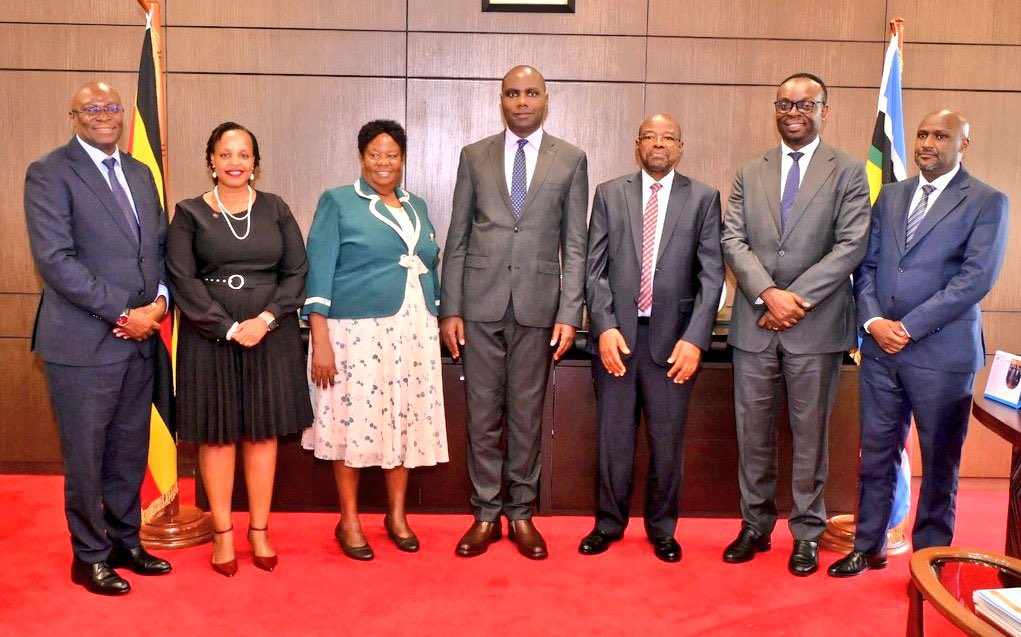
When Mr Julius Kakeeto, the Managing Director of Pearl Bank, walked into a meeting with Finance Minister Henry Musasizi on Thursday morning, he carried with him numbers that tell a story about what an indigenous bank, given the right conditions, can do for a country trying to remake its economy.
Five million Ugandans brought into the money economy. Thirty-one thousand, six hundred and forty-two jobs created across the country. Fifty-eight branches reaching deep into districts where the large commercial banks rarely venture. A mobile wallet called Wendi with 2.4 million subscribers, many of them people who will never set foot in a bank branch but who carry a phone and need somewhere safe to keep and move their money.
Hon Minister Musasizi listened. And then he made a declaration that set the tone for the entire meeting. Indigenous banks, he said, have a pivotal role to play in Uganda’s tenfold growth strategy.
Coming from a Finance Minister who has spent his first weeks in office laying the groundwork for a plan to grow Uganda’s economy from $50 billion to $500 billion, it was a statement of strategic intent, a signal that the ambition he has set for the country cannot be delivered by foreign-owned institutions answerable to shareholders in London or Washington, but must be driven by banks that are rooted here, mandated here, and accountable here.
The meeting, which also included Ministers of State Amos Lugoloobi for Planning and Cissy Mulondo for General Duties, covered the strategic direction of Pearl Bank and the support the institution needs to scale its contribution to the national development agenda.
Pearl Bank is government-owned, holds a 13 percent share of Uganda’s banking market, and has built what is, by any measure, a respectable foundation. But Kakeeto told the ministers plainly that foundation is not enough. Significant growth is needed, he said, not incremental, not gradual, but deliberate and urgent, if Pearl Bank and other local banks are to play the role the tenfold growth strategy demands of them.
At the centre of that argument is capital. Pearl Bank needs more of it, Kakeeto explained, to strengthen its liquidity position, to grow its lending to small and medium enterprises, and to begin exerting real downward pressure on the interest rates that have long placed formal credit beyond the reach of most Ugandan businesses and households.
That last point is one of the most consequential in Uganda’s current economic conversation. Borrowing costs in this country remain among the highest in the region, a reality that quietly strangles private sector growth, discourages investment, and ensures that the formal financial system serves a relatively narrow slice of the population. A well-capitalised Pearl Bank, lending competitively and at scale, could begin to change that, not through government directive but through the oldest mechanism in banking: competition.
Musasizi directed the bank to stay focused on sustainable financial inclusion and to continue supporting Agricultural Technology Management Sites, the grassroots agricultural programme that government has been using to drive commercial farming at the parish level.
Hon. Lugoloobi went further, urging the bank not just to support those sites but to dig into their value chains, to find where the financing gaps are, where the commercial opportunity lies, and how the bank can position itself to attract investment into those chains rather than simply waiting for borrowers to arrive at its branches.
It was, in its way, a picture of how Musasizi intends to run his engagement with government-owned financial institutions. Not as a shareholder issuing instructions from a distance, but as a Minister who sits down, listens to the numbers, understands the constraints, and then asks the harder question about what these institutions need to become what the country needs them to be.
This was the second such meeting Musasizi held, following an earlier engagement with Pride Bank Managing Director Veronicah Gladys Namagembe. The pattern is becoming clear. The new Finance Minister is moving through the landscape of government-owned financial institutions one by one, taking stock, asking questions, and beginning to build a picture of how each of them fits into the larger transformation he has committed to delivering.
For Pearl Bank, the conversation with the Minister arrived at a moment of genuine opportunity. The Wendi mobile wallet is growing. The branch network is wide. The track record on financial inclusion is real. What the bank needs now, its Managing Director argued, is the capital and the political backing to scale all of that into something that can genuinely move the needle on Uganda’s economic transformation.
###
What's your reaction?
You may also like
More in:National

Let’s Build Stronger Families for Uganda’s Future, Says Tayebwa
Focus on Climate Action, Tayebwa Tells MPs
President Museveni Fulfils UGX 50 Million Pledge for Fr. Bagumisiriza’s Marriage Book.

“I am Not Willing to Defend Corrupt RDCs,” Minister Babalanda Intensifies Expose the Corrupt Campaign