By Wilfred Arinda Nshekantebirwe
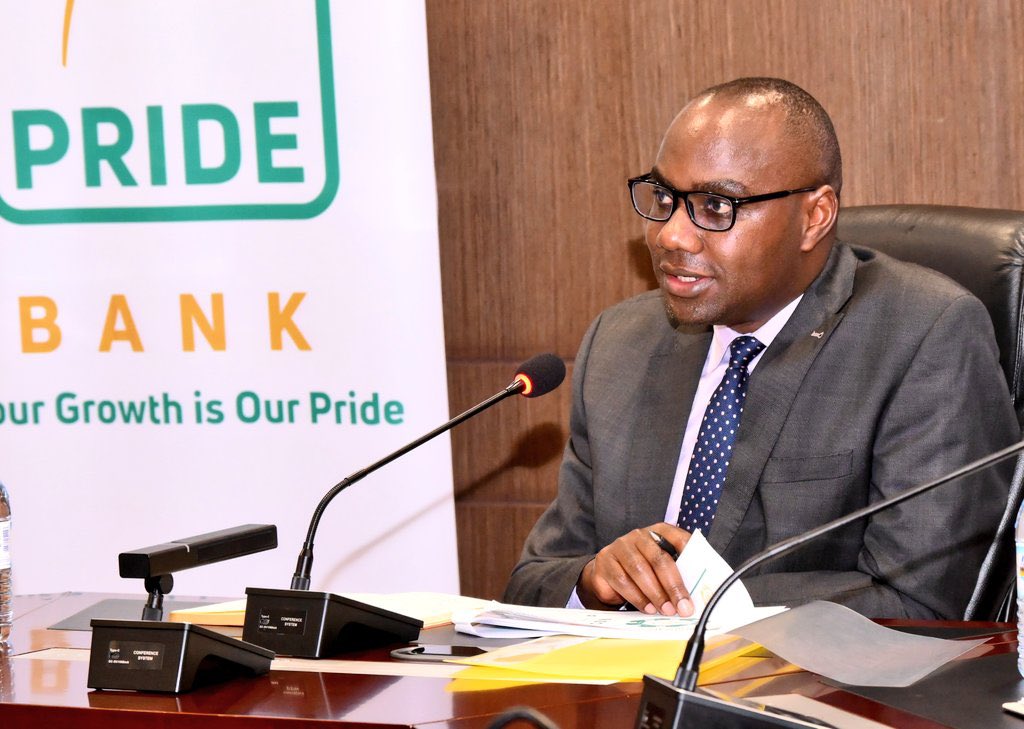
Finance Minister Hon. Henry Musasizi on Thursday received the leadership of Pride Bank Limited, holding discussions with the institution’s Managing Director Veronicah Gladys Namagembe and her team in a meeting that centred on the bank’s performance, its strategic direction, and its role in delivering the government’s financial inclusion and development agenda.
The meeting, which comes as Pride Bank prepares for its annual general meeting next month, gave Musasizi an early window into the operations of one of government’s key financial institutions, and an opportunity to set the tone for what he expects from state-owned financial institutions under his watch as the country’s chief steward of public resources.
Pride Bank, a government-owned Tier II Credit Institution, briefed the Minister on its achievements, current strategic priorities, and its contributions to Uganda’s broader development framework. Namagembe told Musasizi that the bank, operating through 44 branches and three contact offices spread across the country, is actively driving financial inclusion by channelling targeted financing into programmes that sit at the heart of government’s economic transformation agenda.
These include the Parish Development Model, the Grow Project, the Agricultural Credit Facility, and large-scale agriculture financing, each of them designed to pull Uganda’s rural and semi-urban populations into productive economic activity and away from subsistence living.
For Musasizi, whose five-pillar economic agenda includes the explicit goal of ensuring every Ugandan enters the money economy, the work that Pride Bank is doing on the ground is not peripheral to his mandate. It is central to it. A Finance Minister committed to commercialising smallholder farmers and funding the Presidential wealth creation agenda needs financial institutions that can actually reach the last mile, institutions with branches in districts where commercial banks rarely venture and with products designed for borrowers who do not fit the traditional credit profile. Pride Bank’s footprint and focus make it one of the most direct instruments available to the Ministry for translating policy into household-level economic change.
Hon. Musasizi congratulated Pride Bank for the progress it has achieved over the years and for the ambition embedded in its plans ahead, describing the institution’s trajectory as one aimed at transforming it into a premier financial institution. But his most pointed message went beyond congratulations. The Minister underscored the fundamental purpose that must animate everything Pride Bank does, ensuring that Ugandans have access to affordable credit. Not credit as a product. Not credit as a revenue line. Credit as a tool of transformation.
“The real purpose is to transform people’s lives,” Musasizi said, framing affordable access to financing not as a commercial consideration but as a development imperative.
It is a distinction that matters enormously in the Ugandan context, where high interest rates have historically placed formal credit out of reach for the smallholder farmer, the market vendor, the boda boda operator, and the rural woman trying to expand a small enterprise. When borrowing costs remain prohibitive, the gap between those already in the money economy and those still outside it widens rather than closes, regardless of how many branches a bank operates or how many government programmes it is tasked with supporting.
By raising the affordability question directly with Pride Bank’s leadership, Musasizi is signalling that government’s expectation of its own financial institution goes beyond balance sheet performance. A state-owned bank that posts impressive numbers while charging interest rates that ordinary Ugandans cannot afford has, in the Minister’s framing, missed the point. The measure of success for an institution like Pride Bank is not profit alone, it is the number of Ugandan households whose economic circumstances have measurably improved because they were able to access capital on terms that made productive investment possible.
The meeting also carries a broader significance in the context of Musasizi’s opening weeks in office. Having already met the Bank of Uganda Governor to strengthen fiscal and monetary policy coordination, and having chaired his first top management meeting to lay out a five-pillar economic transformation agenda, the Minister is now engaging systematically with the institutional ecosystem through which that agenda will be delivered. Pride Bank is one piece of that ecosystem, but for the millions of Ugandans it serves across its branch network, it is not a small piece.
###
What's your reaction?
You may also like

More in:Economy
Minister Musasizi Warns District Leaders Against Abandoning Anti-Corruption Duties to Balaam.

Minister Musasizi Reaffirms Uganda’s Commitment to EU Partnership to Drive Investment, Trade and Jobs
Minister Musasizi to MPs: Broaden Tax Base, Don’t Just Tax Same People More to Reach 20% Revenue Target
Uganda’s Cash Economy and the Bank of Uganda’s New Cash Withdrawal Limits