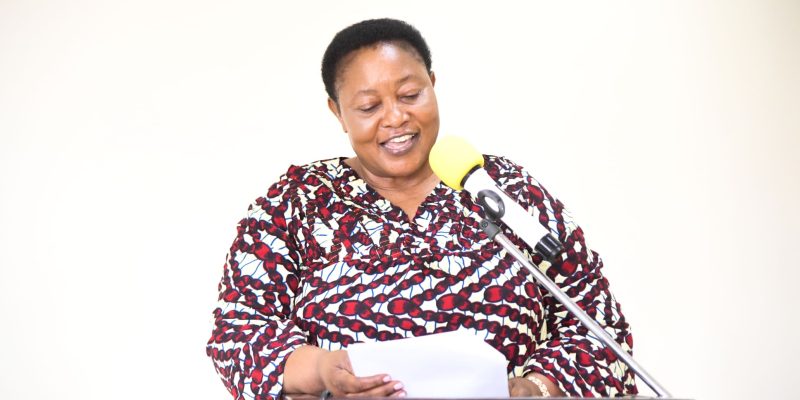
BUSOGA – The Minister for the Presidency and Member of Parliament for Budiope West Constituency, Hon. Babirye Milly Babalanda, cautioned political, administrative and technical leaders in Busoga against corruption, political interference, favouritism and misuse of public resources during the implementation of the Northern Uganda Social Action Fund IV (NUSAF IV).
The Minister made the call Yesterday, at Jinja Nile Resort while addressing Resident District/City Commissioners (RDCs), local government leaders, Chief Administrative Officers, Town Clerks, technical officers and other stakeholders during an engagement to prepare the sub-region for the programme’s rollout.
Hon. Babalanda commended the Office of the Prime Minister and the World Bank for their partnership in implementing the programme, emphasising that its success should be measured by the number of households lifted out of poverty rather than the amount of money spent.
She observed that despite Busoga’s fertile soils, abundant water resources and agricultural potential, poverty, youth unemployment and food insecurity remain significant challenges. Approximately 840,700 people in the sub-region, representing about 12 per cent of Uganda’s poor population, require targeted interventions to improve their livelihoods.
She explained that NUSAF IV presents an opportunity to address these challenges through enterprise grants for agriculture, fisheries and small businesses, labour-intensive public works, entrepreneurship training and other social protection interventions.
The Minister underscored the responsibility of RDCs in monitoring government programmes, directing them to maintain a visible presence in beneficiary communities, regularly inspect project sites, ensure transparent beneficiary selection, investigate suspected fraud and coordinate stakeholders while respecting institutional mandates.
She also urged elected leaders to mobilise communities and promote public participation without turning the programme into a political reward or means of punishing opponents.
“No leader should demand that beneficiaries belong to a particular political group, pay a fee, offer a kickback or surrender part of their grant,” she cautioned.
Hon. Babalanda further tasked Chief Administrative Officers, Town Clerks and technical officers with ensuring compliance with approved implementation procedures, proper documentation, accurate beneficiary records, expenditure controls and accountability requirements.
On resource management, she warned against elite capture, conflicts of interest and the diversion of programme funds to influential individuals, their relatives or political associates at the expense of vulnerable households. She called for strict adherence to beneficiary selection criteria, community verification and the use of authorised payment channels.
She further emphasised the need for accessible grievance-redress mechanisms through which citizens can report fraud, exclusion, delayed payments and misconduct, urging leaders to ensure that complaints are properly documented and addressed.
The Minister encouraged local governments to coordinate NUSAF IV with other poverty eradication initiatives, including the Parish Development Model (PDM), Emyooga, GROW and UWEP, to avoid duplication and double financing while maximising opportunities for household income growth.
She outlined four key areas for assessing programme performance: inclusion of vulnerable households, integrity in the management of resources, quality of project delivery and measurable improvements in household incomes, food security, employment and community resilience.
In a message delivered by Hon. Babalanda, the Minister of State for Northern Uganda, Hon. Beatrice Akello Akori, described the rollout of NUSAF IV in Busoga as a historic milestone, marking the first time the sub-region has benefited from the programme since its establishment in 2003.
NUSAF IV is a Government of Uganda initiative implemented through 104 beneficiary local governments, with support from the Office of the Prime Minister and other government institutions. The programme is financed by the World Bank to the tune of US$276 million, including a US$250 million credit, and will run until December 2031.
Its three priority areas are sustainable livelihoods, resilience and human capital development, and strengthening social protection delivery systems.
Under the programme, poor rural households will receive grants of up to approximately Shs1 million, alongside business skills training, mentorship and market linkages. Young people and women in urban areas will also benefit from entrepreneurship training and business grants.
Other interventions include climate-smart public works, nutrition support for mothers and young children, and direct assistance to extremely poor households unable to participate in public works.
Hon. Akello noted that Busoga, with a population exceeding 4.3 million across 15 local governments, is the most populous of the nine sub-regions benefiting from NUSAF IV and ranks second in poverty levels, with approximately 840,700 people living below the poverty line.
She revealed that about 6,200 mothers with young children in Buyende, Mayuge and Namutumba districts will receive nutrition support and counselling to address anaemia and stunting. Meanwhile, young people and women engaged in the informal economy in Jinja City and the municipalities of Bugiri, Iganga and Kamuli will benefit from entrepreneurship training and business grants.
The Minister also highlighted the importance of establishing the National Social Registry to improve household identification and beneficiary targeting, urging communities to register for National Identity Cards and provide accurate information during household registration exercises.
On accountability, she warned against exploiting beneficiaries, reiterating that no one should pay money to access programme benefits. She noted that the Inspectorate of Government would support monitoring through Community Monitoring Volunteers, community scorecards, interface meetings and investigations into reported cases.
Beneficiaries will also have access to grievance-reporting channels, including SMS, USSD, WhatsApp, toll-free telephone lines and a web portal, while payments will be made through verified bank accounts and mobile money platforms.
Hon. Akello pledged to personally monitor implementation through unannounced visits to project sites and hold responsible officials accountable for delivering the intended results.
In her concluding remarks, Hon. Babalanda appealed to all stakeholders to demonstrate integrity, professionalism and commitment, ensuring that no eligible household is excluded and that programme resources are not diverted or abused.
She urged leaders and communities to work together to ensure NUSAF IV delivers tangible improvements in livelihoods, creates employment opportunities, strengthens household resilience and accelerates Busoga’s socioeconomic transformation.
What's your reaction?
You may also like
More in:Business

Personal care is not a gender issue. It is a matter of health, hygiene and self-confidence
AAYC, NIMD Explore Strategic Partnership to Advance Youth Leadership, Democracy and Peacebuilding
PRESIDENT MUSEVENI URGES SHEEMA FARMERS TO EMBRACE IRRIGATION, COMMERCIAL AGRICULTURE TO FIGHT POVERTY
PRESIDENT MUSEVENI URGES EUROPEAN INVESTORS TO TAP INTO UGANDA’S ECONOMIC OPPORTUNITIES