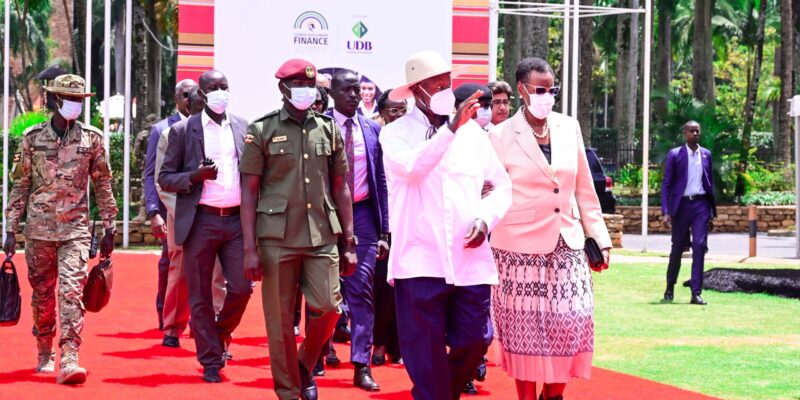
Kampala, Uganda – President Yoweri Museveni on Monday September 1st opened the Uganda Development Finance Summit 2025 at the Speke Resort Convention Centre in Munyonyo, marking a significant gathering of over 400 African leaders, national development bank heads, and global financiers.
The two-day summit, themed “Transforming Africa through National Development Finance Architecture,” aims to address financing challenges and unlock mega-projects in infrastructure, agriculture, and renewable energy, with a bold ten-year strategy targeting agrifood systems by 2035.
Accompanied by his wife, Maama Janet Kataha Museveni, Museveni emphasized the need for “vision, integrity, and patient capital” to drive Africa’s economic transformation. He criticized commercial banks for imposing exorbitant interest rates of 22% which he said far exceeds the current inflation rate of below 5%. He argued that this stifles investment in essential sectors.
“We must embrace saving and capital accumulation, understanding that development requires sacrifice,” Museveni declared, advocating for the Uganda Development Bank (UDB) as a government-led institution to provide stable, affordable credit to productive sectors. A 2023 World Bank study supports this approach, suggesting that development banks in Africa can boost GDP growth by 1.5% annually when focused on infrastructure.
The President’s vision aligns with his decades-long governance philosophy, forged during his guerrilla war leadership in the 1980s, which prioritized long-term national development.
However, the summit’s timing which coincides with his June 2025 re-election bid announcement for 2026 has sparked speculation of political strategy. A 2024 Afro barometer survey revealed that 58% of Ugandans favor development-focused leadership, potentially amplifying Museveni’s image as a champion of progress amid ongoing governance critiques. Yet, the summit is not without controversy.
Critics point to Uganda’s $2.5 billion debt from projects like the Karuma Dam, where cost overruns and delays from 2013 to 2023 have raised questions about mismanagement, as noted in a 2022 IMF report. Opposition voices, including the Forum for Democratic Change (FDC), have long accused Museveni of prioritizing political interests over economic viability, a tension that looms large as the UDB’s role is debated.
The event, hosted by the Uganda Development Bank, builds on a historic legacy of development finance summits in Africa. The first notable gathering, the Third Financing for Development Conference in Addis Ababa in 2015, set the stage by addressing the costly sustainable development goals (SDGs), estimating a need for $11.5 trillion annually to end poverty and achieve food security by 2030.
Uganda’s summit follows this tradition, with Managing Director Patricia Ojangole recently named Chairperson of the Association of African Development Finance Institutions (AADFI) highlighting strategic partnerships, including a $150 million loan agreement with the Arab Bank for Economic Development in Africa (BADEA) to support agro-processing and small enterprises. As the summit unfolds, it promises groundbreaking conversations and networking opportunities, with poets like Irene Mutuzo and Wake 256 opening the event with performances celebrating Africa’s potential. However, the success of Museveni’s vision hinges on transparency and efficient project management challenges that have dogged past initiatives. For now, the eyes of the continent are on Kampala, where the future of African finance hangs in the balance.
What's your reaction?
You may also like

More in:Business
dfcu Deepens Dialogue with Ndeeba Entrepreneurs Through Kyusa Level SME Dine-Out
PRESIDENT MUSEVENI CALLS FOR MORE JAPANESE INVESTMENT, ROAD EQUIPMENT
The Cattle at the Centre of Kalangwa’s Family Dispute

PRESIDENT MUSEVENI COMMISSIONS MBALE ZOO, URGES UGANDANS TO TAP INTO GLOBAL TOURISM MARKET