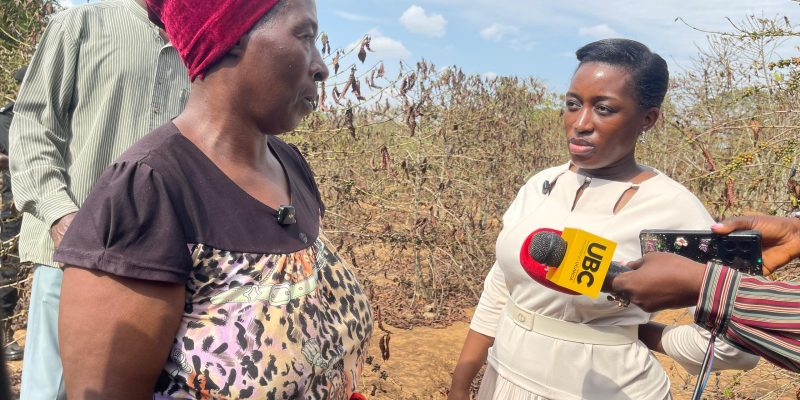
Thousands of farmers in Masaka City are counting heavy losses after nearly four months of prolonged sunshine and drought left coffee, matooke and other food crops severely affected.
The prolonged dry spell has raised concerns about food security and household incomes in an area where many families depend on agriculture for their livelihoods.
During a visit to farmers in Kanabukulilo Village, Bisanje Ward, Kimanya-Kabonera Division in Masaka City on Saturday, State Minister for Local Government Hon. Justine Nameere Nsubuga expressed concern over the impact of the drought on farmers and their livelihoods.
The minister also raised concerns over the reported presence of counterfeit agricultural inputs on the market, saying farmers risk losing both their money and harvests when they purchase ineffective products.
“Farmers raised concerns about the increasing presence of fake fertilisers on the market, saying they have lost money after purchasing products that fail to deliver the expected results,” Nameere said.
She also expressed disappointment with agricultural extension workers and production officers, saying they had not done enough to guide farmers on how to prepare for and respond to prolonged dry spells.
According to Nameere, some of the losses could have been minimised if agricultural officers had adequately advised farmers on appropriate farming practices, water conservation and measures to mitigate the effects of prolonged drought.
Irrigation project
The minister revealed that the Government has recently signed a new irrigation project, with Masaka City among the beneficiaries, aimed at improving farmers’ resilience and sustaining agricultural production during prolonged dry spells.
She said the project would provide an important intervention as farmers increasingly face unpredictable weather patterns that threaten crop production.
Nameere also pledged to engage the Office of the Prime Minister to explore possible support for farmers affected by the drought, while calling for stronger action against counterfeit agricultural inputs.
She said both immediate and long-term interventions were necessary to protect farmers from the growing effects of climate variability.
Coffee farmers hit hard
Coffee farmers are among those counting significant losses.
Oscar Mutebi, who was involved in the distribution of coffee seedlings in Masaka, said the prolonged dry spell had affected many farmers who had invested heavily in coffee production.
“We faced a lot of challenges, with most of the coffee drying in the gardens, yet we had projected coffee farming as a business to get people out of poverty,” Mutebi said.
He said efforts had been made to distribute coffee seedlings to households in line with guidance from the Ministry of Agriculture, Animal Industry and Fisheries.
“I made sure that I adhered to the guidance of the Ministry of Agriculture, Animal Industry and Fisheries by giving out coffee plants door-to-door to households. In Masaka, we received 10 million seedlings. People planted them, but the rains have become unpredictable,” he said.
For farmers, the loss of young coffee plants represents more than just a failed season, as coffee takes several years of investment before generating significant returns.
Zainab Nakidde, a coffee farmer in Masaka City, urged fellow farmers not to lose hope despite the challenges.
She encouraged farmers to remain committed to agriculture and continue preparing their gardens for the return of the rains.
Call for environmental conservation
Masaka Resident City Commissioner Ahmed Washaki acknowledged the prolonged dry conditions in the area and appealed to residents to remain patient while closely monitoring and caring for their farms.
He also linked changing weather patterns to environmental degradation, urging communities to take greater responsibility for protecting wetlands and other natural resources.
“We’ve faced heavy rains here. I also think we need to conserve our environment. Environmental degradation and wetland encroachment cause such scarcity of rain,” Washaki said.
The minister was accompanied during the visit by the Masaka Resident City Commissioner.
For the affected farmers, however, the immediate concern remains how to recover from the losses while preparing for increasingly unpredictable seasons. The planned irrigation intervention, alongside stronger agricultural extension services and measures against counterfeit inputs, could offer a lifeline if effectively implemented.
What's your reaction?
You may also like



More in:Business

Minister Babalanda Calls for Financing Architecture to Match Uganda’s US$500 Billion Growth Ambition by 2040

PRESIDENT MUSEVENI COMMENDED FOR SKILLING INITIATIVE AS STATE HOUSE ANNOUNCES NEW HUB IN BUSOGA
Namayingo Farmers Confront Sugar Council Over Delayed CN Sugar Licence

From Fragmented Processes to Integrated Operations: CINAT Technologies Launches GRIND ERP