President Yoweri Kaguta Museveni, also the National Resistance
Movement (NRM) Presidential flag bearer for 2026 general elections,
has said the government will look into ways of resolving persistent water
shortages in Lwengo District.
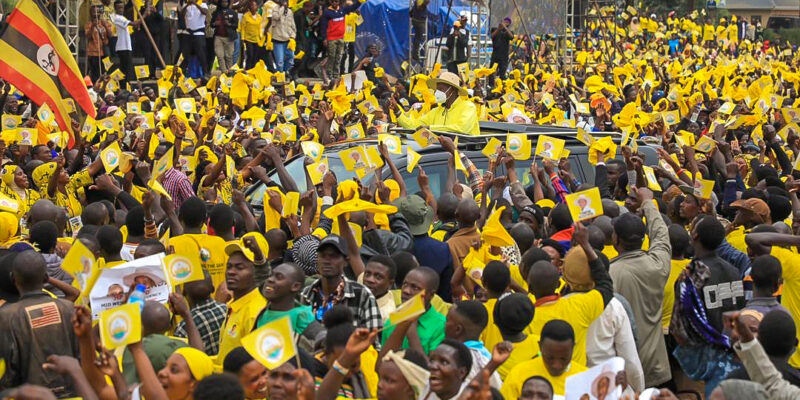
While addressing thousands of supporters during a campaign rally at
Mbirizi Seed Secondary School in Lwengo today, President Museveni
noted that while progress has been made, the district still has a
challenge of water shortage due to drought, a problem he said requires
further government intervention.
“For a long time, this area has had issues of water shortage due to
drought, we shall put our efforts to ensure that we solve this problem,”
he said.
“I have therefore asked Hon. Cissy Namujju, together with Moses
Byaruhanga from my office, to prepare a clear report on the water
situation in this area.”
Out of 438 rural villages in Lwengo, 320 villages currently have access
to a safe water source, while 118 villages still lack access to safe water.
Lwengo is served by several piped water systems, including Nkoni
Town, which supplies about 55,150 people; Mbirizi, serving 38,590
residents; Kyazanga, with 22,000 beneficiaries; Kinoni, serving 11,790
people; and Kamuzinda Town, which serves 7,729 residents.
Despite these facilities, President Museveni said the water situation in
the district remains a concern.
“I will look into this issue so that we can solve the water challenges
here,” the President said.
He linked the shortages largely to prolonged dry spells, noting that
limited water access affects household welfare, sanitation, and
agricultural production.
The President said the government is continuing to invest in road
infrastructure to improve access to markets and social services.
Planned works include the Sembabule–Matete–Mbirizi road, the
Kyabakuza–Kiwangala road, and the
Lyantonde–Lumbugu–Lwamagwa–Rakai road.
On electricity, President Museveni said power has reached all districts
and pledged that the remaining sub-counties in Lwengo without
electricity will be connected.
He also highlighted progress in education, noting that Lwengo has 132
government primary schools and nine government secondary schools,
alongside private institutions.
In the health sector, the President cited ongoing renovations at
Kyazanga Health Centre IV, expansion of maternity wards at Kiwangala
and Naanywa, and plans to upgrade Kisansala Health Centre II in
Kkingo Sub-county to a Health Centre III. Lwengo Health Centre IV now
has a functional digital X-ray machine.
President Museveni reiterated his call for households to adopt the Four-
Acre Model as a pathway out of subsistence farming.
“One acre for coffee, one for fruits, one for food crops, and one for
pasture and livestock,” he said.
He also praised beneficiaries of the Masaka Presidential Skilling Hub,
saying skills training is enabling young people to create jobs and
generate income.
Among the beneficiaries is Allan Mulira, who trained in welding, said the
programme helped him secure employment and later start his own
enterprise.
Noreen Nansumba, who trained in bakery, said she now runs a poultry
project and employs a worker.
The President urged residents to continue supporting the NRM, saying
peace and steady investment remain key to Uganda’s development.
President Museveni also handed over the NRM flags to aspiring
Members of Parliament, LC V chairperson, councillors, and other party
candidates in Lwengo District, formally endorsing their participation in
the upcoming elections.
On her part, Rt. Hon. Anitah Among, Speaker of Parliament and NRM
Second National Vice Chairperson (Female), welcomed the President,
praising his leadership and commitment to the district.
“We welcome you, Your Excellency, to Lwengo. Your presence here
strengthens our communities and reminds us of the progress we have
made under your leadership,” she said.
She also highlighted the impact of government projects in the district,
including road upgrades, electricity expansion, and the Masaka
Presidential Skilling Hub, which she said has empowered young people
to gain skills, create jobs, and generate income.
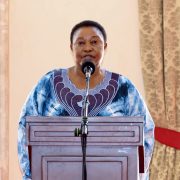
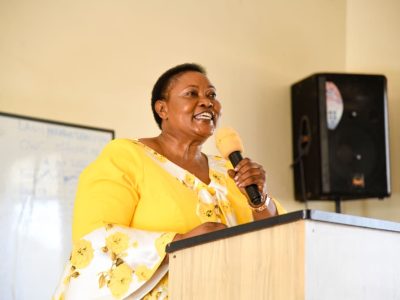
The Woman Member of Parliament for Lwengo District and NRM District
Chairperson, Hon. Cissy Namujju, started by warmly welcoming the
President, recalling Lwengo’s historical role in the liberation struggle.
“Your Excellency, we welcome you to Lwengo, one of the districts where
you fought from while you were in the bush,” she said.
Hon. Namujju noted that according to the 2024 National Population
Census, Lwengo District has a population of 325,263 people, spread
across 10 sub-counties and town councils, 45 parishes and 438 villages.
Hon. Namujju reported that Lwengo has 45 PDM SACCOs, which have
cumulatively received Shs16.056 billion. Of this amount, Shs13.795
billion, representing 86.22 percent has been disbursed to 14,175
households.
“Out of our 68,671 households, only 20.64 percent have so far benefited
from PDM,” she said, adding that 54,496 households, or 79.35%, remain
outside the programme, including those already participating in the
money economy.
She further revealed that the district hosts 54 Emyooga SACCOs with
5,948 members, which have received Shs2.46 billion in government
funding.
Turning to education, Hon. Namujju said Lwengo District has 132
government primary schools and 228 private primary schools, alongside
nine government secondary schools and 44 private secondary schools.
She noted that all government secondary schools offer Universal
Secondary Education (USE) and Universal Post-O-Level Education and
Training, with a combined enrollment of 8,002 learners.
“Out of our 45 parishes, 37 have at least one government primary
school, while eight parishes still lack one,” she said.
Hon. Namujju added that eight out of ten sub-counties currently have a
government secondary school, but the government is addressing the
gap through the construction of two seed secondary schools.
“Once these schools are completed, every sub-county in Lwengo will
have a government secondary school,” she said.
Looking ahead, Hon. Namujju said the government plans to upgrade
existing piped water systems and develop the Katovu Piped Water
Supply and Sanitation System to accelerate progress toward universal
coverage.
She also outlined completed water-for-production interventions,
including valley tanks and irrigation sites in Kisekka, Lwengo Rural and
Keikolongo, benefiting dozens of farmers and supporting livestock
production.
The event was attended by NRM Central Executive Committee (CEC)
members, Members of Parliament, religious and cultural leaders, as well
as thousands of supporters.
What's your reaction?
You may also like
More in:National
Tayebwa Issues Stern Warning to Ineffective Parliamentary Committees
Minister Babalanda Urges Ugandans in Diaspora to Invest at Home and Champion Uganda’s Global Image
Minister Babalanda Roots for Coordination, Accountability to Drive Wealth-Creation
We Must Honor the Builders of PLU in Western Uganda