President Yoweri Kaguta Museveni has urged the National Resistance
Movement (NRM) leaders in Bugisu sub-region to remain steadfast,
reject what he described as lies and distortions from opposition
politicians, and instead champion government priorities of wealth
creation, industrialization, and value addition.
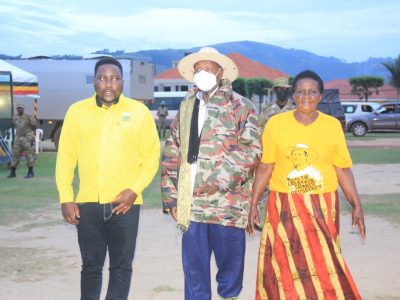
Speaking to 17,725 NRM leaders gathered at Mbale Secondary School
grounds on Sunday, November 16, 2025, President Museveni, who is
also the NRM national chairman, accused the opposition of spreading
misinformation, misunderstanding national planning frameworks, and
prioritizing issues such as salaries and allowances at the expense of
strategic investments that stimulate long-term economic transformation.
“NRM has no problem.
Our analysis is correct, and our strategy is
correct. That’s why we were able to defeat all these groups, even in the
war, even when we started with 27 people,” President Museveni said.
He emphasized that while the NRM attempts to work harmoniously with
all Ugandans, the opposition continues to mislead the population and
push agendas that do not align with national development priorities.
President Museveni also listed power generation, industrial parks, and
strategic road projects as critical investments that unlock employment,
stimulate industrial growth, and expand the tax base.

He cited the recurrent debate around the Mbale– Namagumba–
Bududa–Nalugugu road, noting that while such projects are important,
Uganda’s development plan must account for broader national interests.
“Sometimes the priorities are not correct. The other day in Bududa and
Namisindwa, we were talking about the circular road. We would have
done these roads long ago, but the priorities of our partners are not
always the same,” he explained.
President Museveni had no kind words for other presidential candidates
in the 2026 presidential race, some of whom were in parliament but
prioritized salaries and allowances over national development and
wealth creation.
“But what I don’t like are people who make mistakes but later go and tell
lies. Like when my son Nandala Mafabi goes to Namisindwa and says
the road is bad. Yes, but you are the one who delayed it because you
were the one who was in parliament, prioritizing salaries and allowances
for yourself,” he said.

“Maybe if it is Robert Kasibante, and those who have never been to
parliament, I can forgive. But the ones who were in parliament, like
Nadala Mafabi, Mugisha Muntu, Robert Kyagulanyi, Mubarak
Munyagwa, they have no right to speak about anything, because they
had a chance in parliament to think but never did,” President Museveni
stated, further reminding the NRM leaders to be careful when listening to
opposition politicians, saying “they are working to malign and suppress
government achievements.”
He insisted that opposition politicians should not attack the government
over incomplete road works when they themselves allegedly frustrated
earlier attempts to fund such projects.
Uganda’s Growth: “One of the fastest in the world”
President Museveni praised Uganda’s economic progress, citing a
growth rate of 7%, with projections of surpassing 10% once oil
production comes on board.
He pointed to industrial output, hotel investments, and the expansion of
the manufacturing sector as tangible evidence of Uganda’s
transformation.
President Museveni reinforced his point by highlighting Uganda’s rapidly
expanding industrial landscape, pointing to major industrial parks and
their growing employment capacity.
He cited the Sino-Mbale Industrial Park, which now hosts 75 factories
employing 12,000 people, as a prime example of the region’s rising
manufacturing potential.
President Museveni also noted that the Namanve Industrial Park has
grown into a national industrial hub with 273 factories employing 44,000
workers, and the fully established Kapeeka Industrial Zone, as well as
expanding manufacturing clusters in Mukono, Matugga, which together
signal Uganda’s strengthening industrial capabilities.
Matugga, he said, now houses one of the largest pharmaceutical plants
in the world, while Kiira Motors in Jinja is assembling vehicles, marking
Uganda’s strategic entry into the automotive manufacturing sector.
“When I met the Japanese, I told them we’re buying a lot of vehicles
from you. Come and assemble them in Uganda. They refused, but when
I started making my own vehicles, they came running. I said sorry, it’s
too late.”
President Museveni showcased the Karuma Hydropower Dam, which
generates 640 megawatts, surpassing the old Jinja dam that once
produced 150 megawatts but later declined to 60 megawatts due to
outdated equipment.
He reminded the audience that industrialization and value addition would
be impossible without such large-scale energy investments.
“Without that power, we would not have these factories here. The
factories you see are coming because electricity is available.”
He also celebrated the economic success of Kalangala’s palm oil
project, which has enabled Uganda to reduce dependence on imported
soap-making oil from Malaysia.
“I recall during the 1996 election, there was some pressure from Mbale,
Kabale, and even Kasese, where people complained that URA was
overly strict with smugglers from Kenya and the Congo. But this is
because everything here was coming from outside. Now everything is
coming from here,” President Museveni said.
He accused certain local actors and organizations of working against
Uganda’s development agenda. He warned leaders to be cautious of
individuals who, according to him, seek to undermine Uganda’s progress
either for foreign interests or for personal gain.
Value Addition: “Stop Exporting Raw Materials”
President Museveni reiterated point number five of the NRM’s Ten-Point
Programme -value addition, arguing that Uganda loses billions by
exporting raw coffee instead of processing it locally.
He highlighted global statistics to illustrate how much value Uganda is
currently missing out in the coffee sector.
“The coffee, which you depend quite a bit on, they don’t give us enough
money from it because the global value of coffee is USD 460 billion, but
Africa gets only USD 2.5 billion. Why? Because we sell unprocessed
coffee,” President Museveni noted, adding that in Uganda, farmers
currently earn between USD 4.2 and USD 4.5 per kilogram of robusta
coffee, but this could rise to USD 8–9 per kilogram if the coffee was
processed locally.
Furthermore, exported processed robusta could fetch between USD 22
and USD 25 per kilogram, while processed Arabica could bring in as
much as USD 30–40 per kilogram.
He told Bugisu coffee farmers that full cooperation with the government
would help transform their incomes and the national economy.
“But once you all listen to our message, Uganda is so rich that we would
be helping other countries, not the other way around,” he said.
Discussing corruption, President Museveni explained that he introduced
the Local Council (LC) system to counteract corruption inherited from
colonial-era administrative structures. He insisted that LCs must remain
vigilant and supervise civil servants whose misconduct undermines
service delivery.
“Those chiefs were corrupt. I said; let’s get our leaders, the local council
leaders, elected by us, the money they’re stealing is your money,” he
said.
The Speaker of Parliament and NRM’s Second National Vice
Chairperson, Rt. Hon. Annet Anita Among praised President Museveni
for empowering local governance systems through the LC structure. She
described LC 1 chairpersons as “presidents of their villages,” whose
authority is central to community management.
Rt. Hon. Among thanked the President for increasing LC chairperson
salaries from UGX 10,000 to UGX 100,000, arguing that the increment
reflects the importance of grassroots leadership.
“You are the ones supposed to know everybody in your village. There is
nothing that takes place without the authorization of an LC 1.”
She urged leaders to capitalize on their influence to secure an
overwhelming NRM victory in the upcoming elections, noting that the
party’s support base already exists within villages.
“The votes are within our members, not outside,” she said.
Rt. Hon. Among revealed that PDM funds had been expanded to include
UGX 15 million specifically for parish-level leaders and their SACCOs.
The NRM Secretary General, Rt. Hon. Richard Todwong emphasized
that leadership begins at home and at the LC 1 level.
He reminded leaders of their responsibilities as “social doctors” who diagnose and address community challenges.
“Every LC 1 here must be aware of the number of households in this
area, the social and economic issues, and the level of production.”
He urged them to use party structures effectively to deliver votes for
President Museveni and all NRM flag bearers.
Hon. Calvin Echodu, the NRM Vice Chairperson, Eastern Region,
reassured the President that Bugisu remains firmly behind him.
“Your people are mobilized, the structures are ready, and thank you for
being our rallying point,” he said.
The Mbale meeting attracted an extensive delegation consisting of NRM
Central Executive Committee members, District chairpersons, LCV flag
bearers, Member of Parliament flag bearers, District chief secretaries,
Sub-County NRM chairpersons, Parish and village NRM chairpersons,
and LC 1 NRM flag bearers.
What's your reaction?
You may also like
More in:National
Take Parliament to the People, Tayebwa Advise MPs
Minister Babalanda Warns Basoga Against Land Fragmentation, Urges Families to Embrace Wealth-Creation
PRESIDENT MUSEVENI URGES EUROPEAN INVESTORS TO TAP INTO UGANDA’S ECONOMIC OPPORTUNITIES