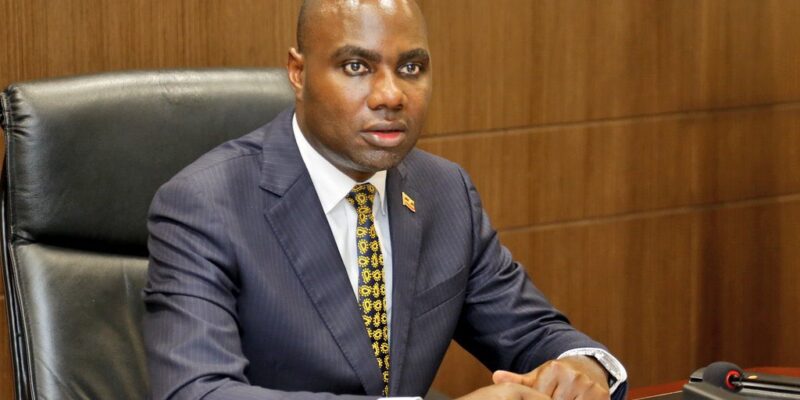
Uganda’s Finance Minister Hon. Henry Musasizi has wasted no time signalling the direction of travel at the Ministry of Finance, Planning and Economic Development.
Chairing his first top management meeting since taking office, Musasizi laid out an ambitious, structured five-pillar agenda that he says will transition Uganda from incremental economic growth to what he described as an “exponential economic take-off”, a vision centred on a tenfold expansion of the country’s economy, aggressive fiscal discipline, and bulletproof management of the country’s anticipated oil revenues.
The meeting, held with the Ministry’s senior leadership team, marks Musasizi’s formal opening salvo as he begins executing the mandate entrusted to him by President Yoweri Kaguta Museveni. It signals clearly that the new Minister intends to run his docket not as a caretaker of the status quo but as an architect of transformation.
The headline commitment that Musasizi placed at the centre of his agenda is as ambitious as it is specific. Uganda’s economy, currently valued at approximately $50 billion, is to be grown tenfold, to $500 billion, under a strategy the Minister described with unmistakable determination.
“We shall relentlessly execute the tenfold growth strategy to turn Uganda into a $500 billion economy,” he told his top management team, framing it not as an aspiration but as a non-negotiable deliverable that the entire Ministry must orient itself around. The target aligns with the government’s broader vision of attaining upper middle-income status and represents one of the most explicitly quantified economic ambitions ever articulated by a Ugandan Finance Minister at the outset of a tenure.
If the $500 billion target is the destination, fiscal discipline is the engine Musasizi intends to run it on. The Minister made clear that the culture at the Finance Ministry is about to change, fundamentally and without negotiation.
“We shall shift the Ministry culture from spending money to enforcing results,” he said, announcing that his tenure will be defined by strict budget discipline, aggressive procurement reforms, and rigorous value-for-money audits across all public projects. This is a direct and deliberate departure from a pattern that has long frustrated development economists, civil society, and ordinary Ugandans alike, one in which budget allocations are made, money is spent, and results remain elusive or unverifiable.
The emphasis on procurement reform is particularly significant, given that procurement irregularities have historically been one of the primary channels through which public resources leak out of Uganda’s development pipeline before delivering any meaningful impact.
On revenue, Musasizi confronted one of Uganda’s most stubborn structural weaknesses, a tax-to-GDP ratio that has long been among the lowest in the region, forcing the government into uncomfortable levels of external borrowing and donor dependency.
“We shall implement the second domestic revenue mobilisation strategy to push our revenue to GDP ratio to at least 20%, cutting external dependency,” he announced. Currently sitting at around 13 to 14 percent of GDP, Uganda’s revenue performance leaves the government perpetually short of the resources needed to fund its own development ambitions.
Closing that gap to 20 percent would represent a transformational shift, one that would reduce vulnerability to fluctuations in donor funding, lower borrowing costs, and give future governments far greater fiscal space to invest in infrastructure, health, education, and social protection without accumulating unsustainable debt.
The fourth pillar of Musasizi’s strategy places the Finance Ministry squarely at the service of President Museveni’s long-standing economic narrative, the commercialisation of Uganda’s smallholder farmers and the integration of subsistence households into the formal money economy.
Hon Musasizi announced that the Ministry will prioritise funding and tracking the commercialisation of smallholders to ensure that every Ugandan enters the money economy, representing a deliberate alignment between the Ministry’s resource allocation decisions and the on-the-ground delivery of programmes like the Parish Development Model and Emyooga.
The critical word in his framing is “tracking.” Funding wealth creation programmes has never been the problem in Uganda. What has persistently undermined their impact is the absence of rigorous, independent monitoring of whether the money is actually reaching intended beneficiaries and whether measurable changes in household income are following.
Perhaps the most consequential pillar for Uganda’s long-term economic trajectory concerns the management of the country’s anticipated oil revenues, a matter that will define Uganda’s fiscal story for generations if handled well, or become its greatest economic tragedy if handled poorly.
Musasizi addressed it with a clarity and caution that will reassure those who have watched other African oil producers squander their resource wealth on consumption, debt, and corruption.
“We shall manage our impending oil revenues with bulletproof institutional guardrails,” he said, adding that oil revenue will be used to build infrastructure and not to fund recurrent expenditure or paper over fiscal shortfalls.
Most significantly, he articulated the overarching philosophy in a single sentence that deserves to stand on its own: the goal is for Uganda to become an oil producer but never an oil dependent economy. That distinction, between producing oil and depending on it, is the lesson that Nigeria, Angola, South Sudan, and Equatorial Guinea each learned the hard way, at enormous cost to their citizens, and the lesson that Norway got right by building a sovereign wealth fund that today stands as a global model.
Taken together, Musasizi’s five pillars paint the portrait of a Finance Minister who has arrived with a clear head, a structured plan, and an evident understanding that Uganda’s economic challenges require more than incremental tinkering.
The $500 billion target demands a complete rethinking of how the economy is structured and incentivised. The discipline agenda requires the political courage to confront waste and procurement corruption in a system where both have powerful protectors. The revenue mobilisation target means broadening the tax base in ways that will inevitably be resisted.
The wealth creation agenda demands results-based management in a public service culture that has historically rewarded process over outcome. And the oil governance framework requires building institutions strong enough to withstand the political pressures that resource wealth invariably generates.
None of this is easy. All of it is necessary. And the fact that Musasizi named all five publicly, in his very first management meeting, suggests he understands that announcing accountability is itself a form of accountability.
###
What's your reaction?
You may also like

More in:Economy
GROW Project Raises Government Wealth-Creation Investments to UGX 10.75 Trillion
Minister Musasizi Warns District Leaders Against Abandoning Anti-Corruption Duties to Balaam.

Minister Musasizi Reaffirms Uganda’s Commitment to EU Partnership to Drive Investment, Trade and Jobs
Minister Musasizi to MPs: Broaden Tax Base, Don’t Just Tax Same People More to Reach 20% Revenue Target